9/5/06 – 9/11/06
by C. Zaitz
By now the news has been out and talked about, maybe to death. “Poor Pluto,” people are saying, if they aren’t saying, “I haven’t thought Pluto was a planet for years!” or “Who cares?” I had an emotional reaction to the news as well, though mine took place well after everyone else’s due to being incommunicado for a week. The news hit me hard emotionally, but as usual, my skepticism (cynicism) took over. I’ve lost things before. But a whole planet?
People are sad, mad, or glad. Some don’t care, and a few haven’t even heard yet. Most of us will go our whole lives never seeing Pluto. Who has even thought much about it after third grade? No one even knew it existed until 1930. There are people alive who were born when there were only eight planets in the known solar system. Think how exciting it must have been to read in the paper that a new planet had been discovered!
It’s a sad contrast to reading that an elite group of folks decided that it wasn’t a planet after all, at least not a grown up planet. Dwarf planet sounds diminutive, and rightly so. Pluto surely could never compete with a Venus or a Uranus as far as size, but it does have three moons, or so we think. Yeah, its orbit is wacky, and yes, it’s most likely closely related to other objects being discovered as part of a distant “band” called the Trans-Neptunian objects. The other “dwarf planets” recently discovered also fall into this category. All this is true, and the whole point of trying to classify things was to get a better definition of a planet. I don’t know if this has been accomplished, but regardless, I can’t help thinking that there should have been some nod to the emotional side of science. Because there is one; I’m convinced of it, as cynical as I can be at times.
Why else would folks get so upset about an object that has absolutely no impact on their lives whatsoever, at least gravitationally? Astrologers, for one, refuse to give up Pluto, since it lends such a dark and interesting presence to their readings! But why do we feel like something was taken away from us by Pluto not being called a planet anymore? Nothing has really changed. Pluto hasn’t shrunk since before the vote, and all the other objects we haven’t yet discovered are still going about their business of orbiting, just like the earth. They don’t change when we discover them, but we do. I was enjoying our growing family. I was even ready to call Ceres, that tiny little asteroid, a planet if it meant adding to the family. I strongly disagree that the general public can’t handle having more planets, that it’s too confusing. I don’t get “confused” when more species of plants or animals are discovered, do you? I was psyched that Ceres and Charon were topics of conversation. It felt like growth, like learning. We seem to attach more importance to things when they are part of our circle, our family. Humans are tribal at heart, and Pluto was part of our tribe.
Well, I don’t know if any of this helps, but I can’t ignore it, and I don’t have any answers about how to cheer up disappointed third graders, but I can say that I’m still glad it was all in the news and is still talked about in some circles. We’re all learning.
Until next week, my friends, enjoy the view!
Wednesday, August 30, 2006


Monday, August 28, 2006
Sometimes Bigger is Better
8/29/06 – 9/4/06
by C. Zaitz
For the past weeks I’ve mentioned that Jupiter is the only planet visible in the evening sky, and that you can “catch a glimpse” of it after sunset. However, that’s been rather lame advice. There’s much more fun to be had with a telescope. But telescopes are expensive, so this is a great time of year to find your local amateur astronomy club and attend an evening observing session, or “star party.” We are lucky to have several fine clubs in our area. The clubs are friendly, social, and have access to dark observing spots, plus they always bring big telescopes so you can enjoy the benefits of Aperture!
Aperture is what matters in a telescope. Even though the word means “opening,” it refers to the size of the light gathering mechanism within. In most popular telescopes, it’s a mirror. Originally it was a glass lens, but glass is heavy and fragile, prone to cracking and chipping. Mirrors are still glass, but not solid glass, and only one side has to be ground to perfection, rather than both sides of a lens. You can make mirrors pretty big, and the bigger the mirror, the better the telescope.
Why is bigger better? What are we trying to do with a telescope? Many people think that telescopes “magnify” light, but it might be better to say they “collect” light. Objects in the night sky are very far away. By the time light from a distant object reaches us, it’s pretty faint and spread out. When you collect rain water, you use a big tarp and funnel it into a barrel. The bigger the tarp, the more drops you can collect. With telescopes, the mirror is the tarp. The bigger the mirror, the more photons of light it collects, and the better you can funnel or focus the light to see distant objects. The cool thing is that if you double the aperture on a telescope, you quadruple the amount of light you can gather.
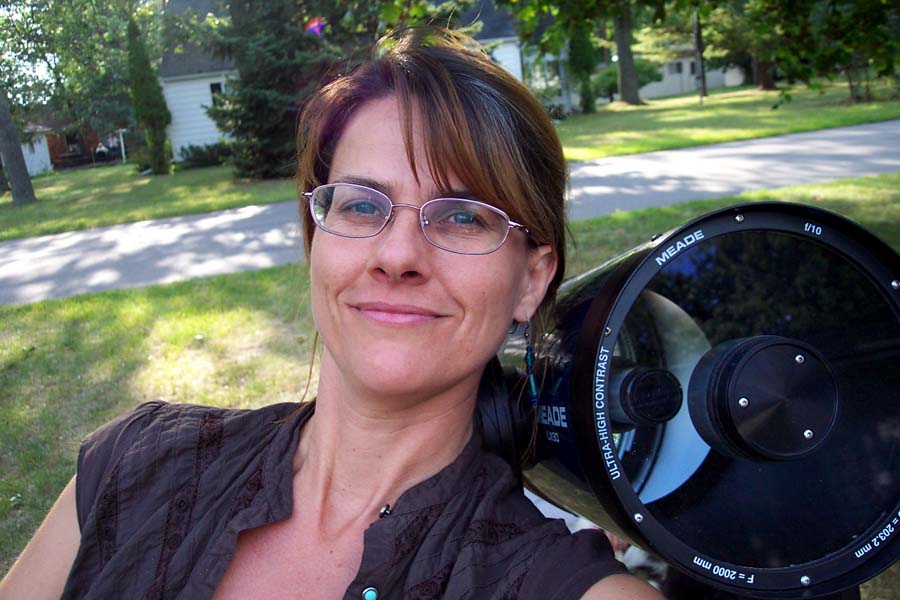
I have just come into some aperture. I have had a 4 inch Astroscan telescope that my parents bought when I was young. Recently they arrived for a week at the cottage bearing gifts. For my husband, a beautiful set of hand made saw horses. For me, an 8 inch LX90 Meade Schmidt-Cassegrain telescope. I was flabbergasted. I named it Carl.
Through the Astroscan, Jupiter looked like a big dot with four tiny specks around it. Through Carl, Jupiter looked like Jupiter with its four largest moons dancing around it. It was impressive. We had a family star party: we toasted marshmallows in the campfire and toured the night sky. We saw M13, the globular cluster in Hercules, the Ring Nebula in Lyra, and the Andromeda galaxy, over 2,000,000 light years away. It was very cool.
Sure there are bigger, more expensive telescopes out there, but Carl and I will have lots of fun together touring the dark skies of Port Austin. Everyone’s experience of the night sky is special, no matter if you own a really big ‘scope or just go out in the backyard with binoculars and locate Jupiter in the western sky. The key is to do it, to give yourself and anyone you can drag out with you the experience of remembering how big and beautiful the universe is. But if you can borrow someone’s aperture AND get a cool explanation of what you’re looking at, well, that’s a Star Party!
Until next week, my friends, enjoy the view!

by C. Zaitz
For the past weeks I’ve mentioned that Jupiter is the only planet visible in the evening sky, and that you can “catch a glimpse” of it after sunset. However, that’s been rather lame advice. There’s much more fun to be had with a telescope. But telescopes are expensive, so this is a great time of year to find your local amateur astronomy club and attend an evening observing session, or “star party.” We are lucky to have several fine clubs in our area. The clubs are friendly, social, and have access to dark observing spots, plus they always bring big telescopes so you can enjoy the benefits of Aperture!
Aperture is what matters in a telescope. Even though the word means “opening,” it refers to the size of the light gathering mechanism within. In most popular telescopes, it’s a mirror. Originally it was a glass lens, but glass is heavy and fragile, prone to cracking and chipping. Mirrors are still glass, but not solid glass, and only one side has to be ground to perfection, rather than both sides of a lens. You can make mirrors pretty big, and the bigger the mirror, the better the telescope.
Why is bigger better? What are we trying to do with a telescope? Many people think that telescopes “magnify” light, but it might be better to say they “collect” light. Objects in the night sky are very far away. By the time light from a distant object reaches us, it’s pretty faint and spread out. When you collect rain water, you use a big tarp and funnel it into a barrel. The bigger the tarp, the more drops you can collect. With telescopes, the mirror is the tarp. The bigger the mirror, the more photons of light it collects, and the better you can funnel or focus the light to see distant objects. The cool thing is that if you double the aperture on a telescope, you quadruple the amount of light you can gather.
I have just come into some aperture. I have had a 4 inch Astroscan telescope that my parents bought when I was young. Recently they arrived for a week at the cottage bearing gifts. For my husband, a beautiful set of hand made saw horses. For me, an 8 inch LX90 Meade Schmidt-Cassegrain telescope. I was flabbergasted. I named it Carl.
Through the Astroscan, Jupiter looked like a big dot with four tiny specks around it. Through Carl, Jupiter looked like Jupiter with its four largest moons dancing around it. It was impressive. We had a family star party: we toasted marshmallows in the campfire and toured the night sky. We saw M13, the globular cluster in Hercules, the Ring Nebula in Lyra, and the Andromeda galaxy, over 2,000,000 light years away. It was very cool.
Sure there are bigger, more expensive telescopes out there, but Carl and I will have lots of fun together touring the dark skies of Port Austin. Everyone’s experience of the night sky is special, no matter if you own a really big ‘scope or just go out in the backyard with binoculars and locate Jupiter in the western sky. The key is to do it, to give yourself and anyone you can drag out with you the experience of remembering how big and beautiful the universe is. But if you can borrow someone’s aperture AND get a cool explanation of what you’re looking at, well, that’s a Star Party!
Until next week, my friends, enjoy the view!

Wednesday, August 16, 2006
“Plutonic” Relationships
8/20/06 – 8/26/06
by C. Zaitz
Well, it’s finally come out. The IAU’s definition of a planet! How exciting- we’ve all been on the edge of our seats waiting and wondering, “so what is a planet, really?” The International Astronomical Union is the world-wide collection of astronomers making up the body that has been the official arbiter of planetary and satellite nomenclature since 1919. And they don’t take bribes.
Historically and etymologically, the word planet referred to the “wanderers” or the “stars” that moved as the year progressed. As the planets orbit the sun, they appear to move in front of the much more distant stars. Mercury, Venus, Mars, Jupiter and Saturn have been known since people have looked up and noticed them. However, Uranus wasn’t discovered by telescope until 1781 by Sir William Herschel. Neptune was discovered in 1846 by Johann Galle, and Pluto is a mere baby, discovered in 1930 by Clyde Tombaugh.
Thanks to better ground-based and orbiting telescopes, we’ve recently discovered even more members of our solar system. Two more moons of Pluto have been discovered, as well as other small bodies like Sedna and Quaoar with eccentric orbits that can take well over 200 years to orbit the sun, beyond the orbit of Neptune. Pluto, by the way, is substantially smaller than our Moon. Controversy has raged about the definition of a planet, and much of it surrounded Pluto’s status. One of the more vocal opponents of Pluto’s planetary status was Dr. Neil DeGrasse Tyson of NYC’s Rose Center and Hayden Planetarium. His argument was that Pluto was too small to be a planet, and was most likely another Trans-Neptunian Body, such as those mentioned above. But who wants to deny that Pluto is a planet? It’s on all our placemats, mobiles and coloring books!
Here’s the quote: “The IAU therefore resolves that planets and other Solar System bodies be defined in the following way: 1. A planet is a celestial body that (a) has sufficient mass for its self-gravity to overcome rigid body forces so that it assumes a hydrostatic equilibrium (nearly round) shape, and (b) is in orbit around a star, and is neither a star nor a satellite of a planet.” Basically, if it’s round and goes ‘round the sun, it’s a planet. That means you, Mr. Pluto. However, small bodies like Ceres, traditionally called asteroids or minor planets, are technically now planets, but can be called “dwarf planets.” Pluto is now a double planet, joined at the gravitational hip with Charon, but is head of a new subclassification called “Plutons,” namely the Trans-Neptunian objects. 2003 UB313 would fall into the Pluton classification. That would make a grand total of 12 planets in the solar system, pending more discoveries.
As you can see, this is all getting a little more complex than it used to be, but a complex solution was called for. We ran out of names and ways to classify the new discoveries. Dr. Tyson wasn’t mad at Pluto, he was pushing for a clearer, more accurate classification scheme.
The vote on the new scheme takes place in Prague on the 24th of August. Stay tuned!
Meanwhile, nary a planet can be found in our August sky. Jupiter can’t escape the oncoming blast of light from the Sun much longer, and soon will be lost in the glare of sunset. Catch a quick view right at evening twilight in the west. Early morning birds may catch a glimpse of Venus in the east, though she is low and her light will be washed away as the sun rises.
Until next week, my friends, enjoy the view!
For more from the IAU, try: http://www.iau2006.org/mirror/www.iau.org/iau0601/iau0601_resolution.html
by C. Zaitz
Well, it’s finally come out. The IAU’s definition of a planet! How exciting- we’ve all been on the edge of our seats waiting and wondering, “so what is a planet, really?” The International Astronomical Union is the world-wide collection of astronomers making up the body that has been the official arbiter of planetary and satellite nomenclature since 1919. And they don’t take bribes.
Historically and etymologically, the word planet referred to the “wanderers” or the “stars” that moved as the year progressed. As the planets orbit the sun, they appear to move in front of the much more distant stars. Mercury, Venus, Mars, Jupiter and Saturn have been known since people have looked up and noticed them. However, Uranus wasn’t discovered by telescope until 1781 by Sir William Herschel. Neptune was discovered in 1846 by Johann Galle, and Pluto is a mere baby, discovered in 1930 by Clyde Tombaugh.
Thanks to better ground-based and orbiting telescopes, we’ve recently discovered even more members of our solar system. Two more moons of Pluto have been discovered, as well as other small bodies like Sedna and Quaoar with eccentric orbits that can take well over 200 years to orbit the sun, beyond the orbit of Neptune. Pluto, by the way, is substantially smaller than our Moon. Controversy has raged about the definition of a planet, and much of it surrounded Pluto’s status. One of the more vocal opponents of Pluto’s planetary status was Dr. Neil DeGrasse Tyson of NYC’s Rose Center and Hayden Planetarium. His argument was that Pluto was too small to be a planet, and was most likely another Trans-Neptunian Body, such as those mentioned above. But who wants to deny that Pluto is a planet? It’s on all our placemats, mobiles and coloring books!
Here’s the quote: “The IAU therefore resolves that planets and other Solar System bodies be defined in the following way: 1. A planet is a celestial body that (a) has sufficient mass for its self-gravity to overcome rigid body forces so that it assumes a hydrostatic equilibrium (nearly round) shape, and (b) is in orbit around a star, and is neither a star nor a satellite of a planet.” Basically, if it’s round and goes ‘round the sun, it’s a planet. That means you, Mr. Pluto. However, small bodies like Ceres, traditionally called asteroids or minor planets, are technically now planets, but can be called “dwarf planets.” Pluto is now a double planet, joined at the gravitational hip with Charon, but is head of a new subclassification called “Plutons,” namely the Trans-Neptunian objects. 2003 UB313 would fall into the Pluton classification. That would make a grand total of 12 planets in the solar system, pending more discoveries.
As you can see, this is all getting a little more complex than it used to be, but a complex solution was called for. We ran out of names and ways to classify the new discoveries. Dr. Tyson wasn’t mad at Pluto, he was pushing for a clearer, more accurate classification scheme.
The vote on the new scheme takes place in Prague on the 24th of August. Stay tuned!
Meanwhile, nary a planet can be found in our August sky. Jupiter can’t escape the oncoming blast of light from the Sun much longer, and soon will be lost in the glare of sunset. Catch a quick view right at evening twilight in the west. Early morning birds may catch a glimpse of Venus in the east, though she is low and her light will be washed away as the sun rises.
Until next week, my friends, enjoy the view!
For more from the IAU, try: http://www.iau2006.org/mirror/www.iau.org/iau0601/iau0601_resolution.html
Wednesday, August 09, 2006
Seeing is Believing
8/13/06 – 8/19/06
by C. Zaitz
Often we are torn between wanting to believe in something and knowing that things may not be just as we wish. I have been accused lately of being a “scientist.” Normally I’d be flattered, but when it’s said with a little grimace and a funny tone of voice, I figure it’s akin to a curse.
I grew up believing in lots of things from Santa to Prince Charming. I believed in Heaven and Hell, and I learned the doctrines and dogma that would get me to one place or the other. But when I realized that there were all sorts of good people who were never exposed to these doctrines and therefore were doomed, I began to reject certain ideas. Soon everything was under my skeptical scrutiny. The more I learned about the universe at large, and more importantly, the universe that each person perceives uniquely, the more I realized that the human brain is so complex and capable of such a gamut of perceptions that we really don’t need to go outside ourselves to find ghosts and myths and gods and devils. However, we prefer to have them externally located, present company included, so we keep looking for demons and angels out in the universe.
I listen with envy when people tell me about their fantastic experiences. I always try to relate, and my mind is always trying to understand and make sense of clues in the stories. I know I take a skeptical approach, but I don’t think that’s a bad thing. I listen to stories, but I don’t always buy them. I buy that the teller does, however, and it is never my intention to change anyone’s belief. I am guilty of trying to interject some skepticism into their thinking. Thus I get labeled “scientist.” If they only knew; a substantial part of my interest in their ghost stories is wonder. I wonder why no dead relative has made a nocturnal visit. Why haven’t any aliens abducted me? Am I so boring that no one wants to haunt me or capture my DNA for some future planet’s repopulation?
I want to believe. If some big-eyed alien crooked his three fingers at me and gestured me to go aboard his ship, I’d be up the ramp in a New York minute. I want to talk with dead people and see who I was in a past life. But I’m a “scientist” and I am not “open” to these possibilities, apparently. As my crop circle loving husband reminds me, it’s the “open-minded” scientists that make the big break-throughs. However, Kepler had to divest from his superstitious thinking to figure out that the planets don’t circle the sun, they travel in ellipses. Galileo, Newton, and even Einstein all had to distance themselves from dogmatic beliefs to look at the evidence. They key word for me is evidence. Without that, it’s not science. And while evidence can sometimes be subjective, scientific evidence is the best hope we have of ferreting out the mechanics of the universe. Cars don’t run on witchcraft.
Having an open mind is not a bad thing. Neither is checking snopes.com to see if the latest chain email is a hoax. If something can be explained without resorting to aliens and ghosts, then why blame it on a ghost? I’m asking, ghosts…and I’m free for a haunting tonight!
While I’m waiting, we can all spy Jupiter as it fades into the sunset. The other planets are too near the sun’s light to be seen.
Until next week, my friends, enjoy the view!
by C. Zaitz
Often we are torn between wanting to believe in something and knowing that things may not be just as we wish. I have been accused lately of being a “scientist.” Normally I’d be flattered, but when it’s said with a little grimace and a funny tone of voice, I figure it’s akin to a curse.
I grew up believing in lots of things from Santa to Prince Charming. I believed in Heaven and Hell, and I learned the doctrines and dogma that would get me to one place or the other. But when I realized that there were all sorts of good people who were never exposed to these doctrines and therefore were doomed, I began to reject certain ideas. Soon everything was under my skeptical scrutiny. The more I learned about the universe at large, and more importantly, the universe that each person perceives uniquely, the more I realized that the human brain is so complex and capable of such a gamut of perceptions that we really don’t need to go outside ourselves to find ghosts and myths and gods and devils. However, we prefer to have them externally located, present company included, so we keep looking for demons and angels out in the universe.
I listen with envy when people tell me about their fantastic experiences. I always try to relate, and my mind is always trying to understand and make sense of clues in the stories. I know I take a skeptical approach, but I don’t think that’s a bad thing. I listen to stories, but I don’t always buy them. I buy that the teller does, however, and it is never my intention to change anyone’s belief. I am guilty of trying to interject some skepticism into their thinking. Thus I get labeled “scientist.” If they only knew; a substantial part of my interest in their ghost stories is wonder. I wonder why no dead relative has made a nocturnal visit. Why haven’t any aliens abducted me? Am I so boring that no one wants to haunt me or capture my DNA for some future planet’s repopulation?
I want to believe. If some big-eyed alien crooked his three fingers at me and gestured me to go aboard his ship, I’d be up the ramp in a New York minute. I want to talk with dead people and see who I was in a past life. But I’m a “scientist” and I am not “open” to these possibilities, apparently. As my crop circle loving husband reminds me, it’s the “open-minded” scientists that make the big break-throughs. However, Kepler had to divest from his superstitious thinking to figure out that the planets don’t circle the sun, they travel in ellipses. Galileo, Newton, and even Einstein all had to distance themselves from dogmatic beliefs to look at the evidence. They key word for me is evidence. Without that, it’s not science. And while evidence can sometimes be subjective, scientific evidence is the best hope we have of ferreting out the mechanics of the universe. Cars don’t run on witchcraft.
Having an open mind is not a bad thing. Neither is checking snopes.com to see if the latest chain email is a hoax. If something can be explained without resorting to aliens and ghosts, then why blame it on a ghost? I’m asking, ghosts…and I’m free for a haunting tonight!
While I’m waiting, we can all spy Jupiter as it fades into the sunset. The other planets are too near the sun’s light to be seen.
Until next week, my friends, enjoy the view!
Wednesday, August 02, 2006
Dancing Stars
8/6/06 - 8/12/06
by C. Zaitz
I did a google search for “arabic stars” recently, and I landed at a bellydance site. Funny, I had just visited my dance teacher, Princess Madiha. She’s a real princess, living here in the Detroit Metropolitan Area. Madiha's mother was of the Awabdi family, originally a royal family in Syria. When Madiha's grandfather, Prince Halil Awabdi, died in a power struggle in the late 1800s, the family lost all their power and wealth. Her mother later married into a farming family. Both she and Madiha are entitled to retain the title of "Princess" in memory of their heritage.
Princess Madiha is one of those special people who enrich your life in ways it takes years to fully appreciate. She not only taught me how to dance, but how to express the beauty in a kind of music that was new to me. She always said she didn’t have blood in her veins, she had music instead. She always tells her students that until the music and movements are part of our vocabulary, we’d always dance with a foreign accent.
I had been researching Arabic star names. The majority of star names are of Arabic origin. This is a little known fact, since it’s assumed that the Greeks named everything in the sky. Greek civilization was intensely interested in constellations and myths. Most of the constellations familiar to us today are of Greek origin, but the Greeks weren’t as interested in individual stars. It was the Arabs, between perhaps the 6th – 12th centuries, that catalogued and named many stars. They used the stars for time keeping, so they needed to know when individual stars rose and set. Western pronunciation has mutilated some of the names. Ibt al-Jauza is the origin of the name Betelgeuse. Its meaning is clearer than its pronunciation. It means the “armpit of the central one.” Betelgeuse marks the right armpit of Orion, the mighty hunter. His foot is marked by a star named Rigel. In Arabic, “ar-rijl” means “the foot.” The names are to the point.
The names of the constellations and planets come from the language of the Romans, Latin. However, the Romans adopted and assimilated the vast pantheon of gods and goddesses, heroes and witches from Greek culture, which in turn had assimilated images and symbols from even older cultures. The ancient Sumerians and Babylonians were the first to write down their ideas, but I am pretty sure that folks made up star pictures even before there was writing. Humans have a strong impulse to recognize patterns in things, and the sky is a good example of this. I’ve always thought it interesting that someone looked up at the teardrop shape of stars in the summer sky and decided that it looked like an Eagle. Or that the teapot shape of Sagittarius reminded the ancients of a centaur, a creature half-horse, half-man. But we look at the constellations with a “modern, foreign accent” and are ignorant of the very heavy and important symbolism the constellations once carried to cultures who relied on the stars to tell them stories of life and of time.
When you look up into the sky, you see the same star patterns that people have seen since there have been people, but the planets are always in motion. Jupiter has been pretty much the same all summer, though he is creeping toward the western sunset as summer heads down to the finish line. The other planets are basking in the Sun’s glow, and won’t be seen for a few more months.
Until next week, my friends, enjoy the view!
by C. Zaitz
I did a google search for “arabic stars” recently, and I landed at a bellydance site. Funny, I had just visited my dance teacher, Princess Madiha. She’s a real princess, living here in the Detroit Metropolitan Area. Madiha's mother was of the Awabdi family, originally a royal family in Syria. When Madiha's grandfather, Prince Halil Awabdi, died in a power struggle in the late 1800s, the family lost all their power and wealth. Her mother later married into a farming family. Both she and Madiha are entitled to retain the title of "Princess" in memory of their heritage.
Princess Madiha is one of those special people who enrich your life in ways it takes years to fully appreciate. She not only taught me how to dance, but how to express the beauty in a kind of music that was new to me. She always said she didn’t have blood in her veins, she had music instead. She always tells her students that until the music and movements are part of our vocabulary, we’d always dance with a foreign accent.
I had been researching Arabic star names. The majority of star names are of Arabic origin. This is a little known fact, since it’s assumed that the Greeks named everything in the sky. Greek civilization was intensely interested in constellations and myths. Most of the constellations familiar to us today are of Greek origin, but the Greeks weren’t as interested in individual stars. It was the Arabs, between perhaps the 6th – 12th centuries, that catalogued and named many stars. They used the stars for time keeping, so they needed to know when individual stars rose and set. Western pronunciation has mutilated some of the names. Ibt al-Jauza is the origin of the name Betelgeuse. Its meaning is clearer than its pronunciation. It means the “armpit of the central one.” Betelgeuse marks the right armpit of Orion, the mighty hunter. His foot is marked by a star named Rigel. In Arabic, “ar-rijl” means “the foot.” The names are to the point.
The names of the constellations and planets come from the language of the Romans, Latin. However, the Romans adopted and assimilated the vast pantheon of gods and goddesses, heroes and witches from Greek culture, which in turn had assimilated images and symbols from even older cultures. The ancient Sumerians and Babylonians were the first to write down their ideas, but I am pretty sure that folks made up star pictures even before there was writing. Humans have a strong impulse to recognize patterns in things, and the sky is a good example of this. I’ve always thought it interesting that someone looked up at the teardrop shape of stars in the summer sky and decided that it looked like an Eagle. Or that the teapot shape of Sagittarius reminded the ancients of a centaur, a creature half-horse, half-man. But we look at the constellations with a “modern, foreign accent” and are ignorant of the very heavy and important symbolism the constellations once carried to cultures who relied on the stars to tell them stories of life and of time.
When you look up into the sky, you see the same star patterns that people have seen since there have been people, but the planets are always in motion. Jupiter has been pretty much the same all summer, though he is creeping toward the western sunset as summer heads down to the finish line. The other planets are basking in the Sun’s glow, and won’t be seen for a few more months.
Until next week, my friends, enjoy the view!
Friday, July 28, 2006
Badlands
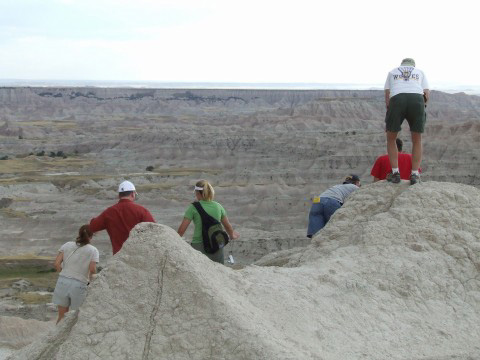
As hot as it will get here next week in southeast Michigan, it won't feel like it did this day of the Big Hike. Toasty, crispy warm with a breeze that drew the sweat right out of your skin. We hiked straight up the crumbling clay, down again and then marched along the open dry plain, watching for rattlers and cacti, wondering how long the hike really would be, and wondering if our spare water jugs would still be somewhere south of boiling in the minivans.
They weren't. This was the day Allison and I gave our paper on the K-T boundary. After the Hike. After the seeming endless trek into hot winds, dry grasses and astoundingly desolate landscape.
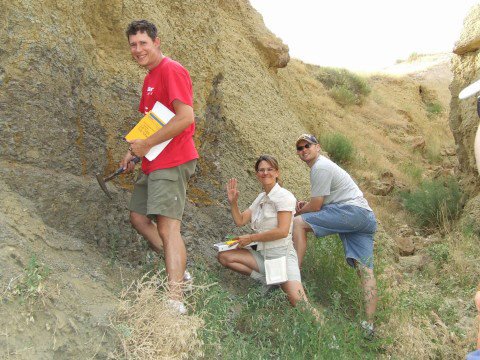
We managed to recover our wits in the five minute drive to the spot where we could see the K-T boundary. This is the famous edge of life, the time spanning the age of the Dinosaurs, ammonites and about 65% of other species on earth. Above the K-T boundary, there are no dinosaur bones. There are no ammonites, there are no psauropods. All gone.

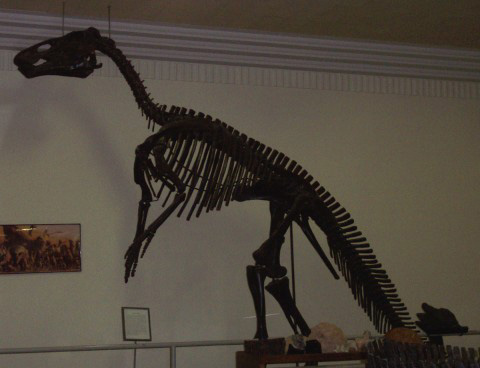
So what do we find in the K-T boundary? Weird stuff, mixed with a more-than-normal amount of the rare element Iridium. Ir is related to platinum, and it's that rare. Not so rare in outer space, however, and it is most likely that the relatively copious amounts of that element found in the K-T boundary is from outer space. Aliens? No, asteroids. Is that what killed the dinosaurs? A giant wad of stone and dust from outer space? It's possible. Asteroid collisions do nasty things to the earth.
I love the earth!
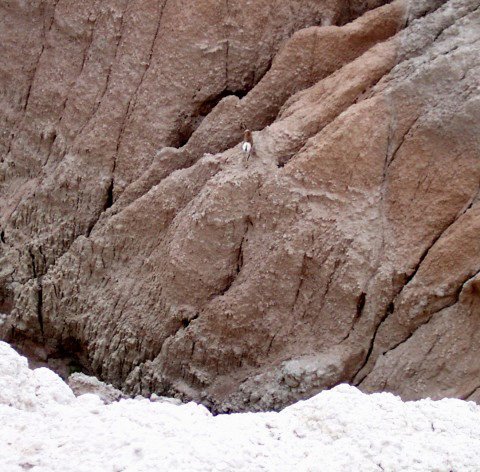
The little white thing you see in the crumbling clay is a deer's butt.
Look what else the earth looks like!

Here's what it looks like on the inside!

It was nice and cool in the cave. Yes, that's me wearing a flannel shirt. I was glad I brought it to South Dakota in July. Though it was in the high 90s outside, it was in the 50s in Rushmore Cave. I prefer the 90s, but that's just me.

Later on...

I was teaching everyone the "Happy George, Sad George" trick with a dollar bill. Luckily Jay had the whole gamut of bills in his wallet so we continued on in the same manner with Hamilton, Jackson, and Grant...what fun. It was even more fun watching Rachel laugh everytime we did it! Jay even had Ben Franklin! Go Jay- drinks all around!
Not fun: Dr. Murray handing me the van keys bright and early the next morning. First shift? Sweet.
Tuesday, July 25, 2006
Baby Did a Bad, Bad Thing
7/30/06 – 8/5/06
By C. Zaitz
I looked at the Sun recently. I didn’t just glance, I stared at it. It wasn’t the mellow, orangey red, romantic looking sunset sun, it was the real deal. It was hot, bright, and burning high up in the noontime sky. I of all people should know better, but I couldn’t help myself. I was walking along the beach in Port Austin. There were high stratocirrus clouds covering the sky, but they were silky and see-through. They were transparent enough to create a gorgeous full circle or halo around the sun. I had sunglasses clipped over my regular glasses, but that’s no excuse. It’s just plain bad to look at the sun.
The sun halo was very striking. I looked as long as I could until my eyes started to water. Then I noticed a partial rainbow arc underneath the ring. I brushed the tears away and looked as much as I could. I began to notice people looking at me, and heard a whispered, “what’s she looking at?” I realized there were kids around and that I was setting a very bad example. But I kept looking up near the sun until things started to go pale. I knew I should stop, that I could be irreversibly damaging my eyes, but it was such an unusual sight that I kept sneaking looks.
I heard my mother’s voice in my head. “You’d better protect your eyes from the sun or you’ll end up with cataracts like your grandmother.” Yikes. To ease my conscience, I am now going to rant about protecting your eyes from the sun. I’m going to wallow in a hypocritical pool for one whole paragraph.
Eye damage is cumulative, like skin damage from UV rays. Eye lens cells are never replaced, so each time you expose them to the sun, you’re chipping away at your vision. You can’t see the damaging rays, and they don’t even hurt. When your eyes water, it’s more from the sheer amount of light trying to enter your eyes as your pupils try to shut down quickly. However, the damage really occurs when the ultraviolet rays enter your pupils. You can get cataracts and eye cancer from sun exposure, and it’s never too early to protect kids from the sun’s damage. Don’t be fooled by the kiddie sunglasses, either- make sure they have 100% UV protection. I most likely gave myself a bit of “sun blindness” or photokerititis from looking at or near the sun, and while the white-out effect goes away, the damage remains. I will most likely get cataracts, if I live long enough. No one will cry for me either, since I am admitting freely that I did a bad, bad thing.
That night, I looked up into the post-sun sky and saw three satellites overhead. They were moving at about the same speed like a small armada. Then I saw a meteor slash through the Summer Triangle. I was glad to have recovered my vision. I kicked myself for being so foolhardy with something so precious. I’ve had fairly bad vision my whole life, and you’d think I’d be more careful about protecting what I can. From now on I will. I promise, Mom.
Besides the distant stars, you can still see Jupiter in the evening. He is still King of the Evening, the brightest thing other than the Moon in the southern night sky. Venus can be seen around 5:30 am in the eastern sunrise.
Until next week, my friends, enjoy the view!
By C. Zaitz
I looked at the Sun recently. I didn’t just glance, I stared at it. It wasn’t the mellow, orangey red, romantic looking sunset sun, it was the real deal. It was hot, bright, and burning high up in the noontime sky. I of all people should know better, but I couldn’t help myself. I was walking along the beach in Port Austin. There were high stratocirrus clouds covering the sky, but they were silky and see-through. They were transparent enough to create a gorgeous full circle or halo around the sun. I had sunglasses clipped over my regular glasses, but that’s no excuse. It’s just plain bad to look at the sun.
The sun halo was very striking. I looked as long as I could until my eyes started to water. Then I noticed a partial rainbow arc underneath the ring. I brushed the tears away and looked as much as I could. I began to notice people looking at me, and heard a whispered, “what’s she looking at?” I realized there were kids around and that I was setting a very bad example. But I kept looking up near the sun until things started to go pale. I knew I should stop, that I could be irreversibly damaging my eyes, but it was such an unusual sight that I kept sneaking looks.
I heard my mother’s voice in my head. “You’d better protect your eyes from the sun or you’ll end up with cataracts like your grandmother.” Yikes. To ease my conscience, I am now going to rant about protecting your eyes from the sun. I’m going to wallow in a hypocritical pool for one whole paragraph.
Eye damage is cumulative, like skin damage from UV rays. Eye lens cells are never replaced, so each time you expose them to the sun, you’re chipping away at your vision. You can’t see the damaging rays, and they don’t even hurt. When your eyes water, it’s more from the sheer amount of light trying to enter your eyes as your pupils try to shut down quickly. However, the damage really occurs when the ultraviolet rays enter your pupils. You can get cataracts and eye cancer from sun exposure, and it’s never too early to protect kids from the sun’s damage. Don’t be fooled by the kiddie sunglasses, either- make sure they have 100% UV protection. I most likely gave myself a bit of “sun blindness” or photokerititis from looking at or near the sun, and while the white-out effect goes away, the damage remains. I will most likely get cataracts, if I live long enough. No one will cry for me either, since I am admitting freely that I did a bad, bad thing.
That night, I looked up into the post-sun sky and saw three satellites overhead. They were moving at about the same speed like a small armada. Then I saw a meteor slash through the Summer Triangle. I was glad to have recovered my vision. I kicked myself for being so foolhardy with something so precious. I’ve had fairly bad vision my whole life, and you’d think I’d be more careful about protecting what I can. From now on I will. I promise, Mom.
Besides the distant stars, you can still see Jupiter in the evening. He is still King of the Evening, the brightest thing other than the Moon in the southern night sky. Venus can be seen around 5:30 am in the eastern sunrise.
Until next week, my friends, enjoy the view!
Friday, July 21, 2006
WHFR
I have an interview on WHFR, a local station this morning at 10:20-ish AM. You can stream it at http://whfr.fm. I'll be talking about the planetarium and education. I have all sorts of thoughts about it. I hope they come out in English.
Update: you can listen to the podcast on their website.
Update: you can listen to the podcast on their website.
Tuesday, July 18, 2006
Somewhere in Time
7/23/06 – 7/29/06
by C. Zaitz
A single glance at the night sky can transport you back in time. The stars are very far away, and their light takes time to travel to us. Even the bright, steady light from Jupiter takes about a half hour to reach us. Starlight can take hundreds or even thousands of years to reach us. I realize that on the scale of our galaxy, which is what we see when we look at the night sky, a human lifetime is pretty short. But my recent week-long foray into geology of the Badlands and the Black Hills of South Dakota and Devil’s Tower in Wyoming left me feeling downright ephemeral. I was looking at rock formations billions of years old. I use the word “billions” all the time when talking about numbers of stars or distances to far away galaxies. But touching rocks that had been buried for billions of years and are now exposed and blowing away in the wind was something different.
The Earth is old, about 4.5 billion years old. The Badlands aren’t quite that old. About 70 million years ago, the rising Rocky Mountains and Black Hills dusted the lands to the east with sediments and sands. Back then the whole middle part of North America was covered with a warm, shallow sea. The sea grew and shrank over time. Dead sea creatures and dust built up layers of limestone, sandstone and clay sediments. Then, a few million years ago, the area of the Badlands began to rise, exposing 70 million year old sediment layers to the wind and rain. Once the clay and sand layers were dissected by rivers, the erosion process took over and created the incredible display of “badlands” that we see today. Hidden in the soft clays are fossilized bones of creatures that used to roam the Earth, such as the gigantic-headed Triceratops and three-toed horses that were smaller than Great Danes.
The granite intrusions of the Black Hills and Devil’s Tower are even older. They are Pre-Cambrian, at least 570 million years old, most likely over a billion years old. But some of the oldest rocks I touched were in Sioux Falls, South Dakota. The pink quartzite found there used to be sand 2 billion years ago. Time, tide and great pressure and heat formed the sand into rock. The rock was hidden for billions of years by layers of sediments, and now has been exposed to the elements through erosion.
Some of the quartzite ended up in the local roads, giving them a particularly curious deep pink color. Both the quartzite and the gas we were combusting in the mini van have been hidden deep in the earth for ages, but now we’re using these resources up in a matter of decades.
I touched some really old rocks, but the Moon showed us the most ancient rocks we can see. I was annoyed at Luna for spilling her light over the night sky all week long. She washed out any chance of seeing a dark star-lit sky. But the 4 billion year old surface of the Moon reminded me of how old things are, and how we are just here briefly, somewhere in a long continuum of time.
The class was taught by Dr. Murray of the University of Michigan at Dearborn. It was an excellent class, and has forever changed the way I look at rocks. And now I don’t feel so old anymore!
Until next week, my friends, enjoy the view.
by C. Zaitz
A single glance at the night sky can transport you back in time. The stars are very far away, and their light takes time to travel to us. Even the bright, steady light from Jupiter takes about a half hour to reach us. Starlight can take hundreds or even thousands of years to reach us. I realize that on the scale of our galaxy, which is what we see when we look at the night sky, a human lifetime is pretty short. But my recent week-long foray into geology of the Badlands and the Black Hills of South Dakota and Devil’s Tower in Wyoming left me feeling downright ephemeral. I was looking at rock formations billions of years old. I use the word “billions” all the time when talking about numbers of stars or distances to far away galaxies. But touching rocks that had been buried for billions of years and are now exposed and blowing away in the wind was something different.
The Earth is old, about 4.5 billion years old. The Badlands aren’t quite that old. About 70 million years ago, the rising Rocky Mountains and Black Hills dusted the lands to the east with sediments and sands. Back then the whole middle part of North America was covered with a warm, shallow sea. The sea grew and shrank over time. Dead sea creatures and dust built up layers of limestone, sandstone and clay sediments. Then, a few million years ago, the area of the Badlands began to rise, exposing 70 million year old sediment layers to the wind and rain. Once the clay and sand layers were dissected by rivers, the erosion process took over and created the incredible display of “badlands” that we see today.
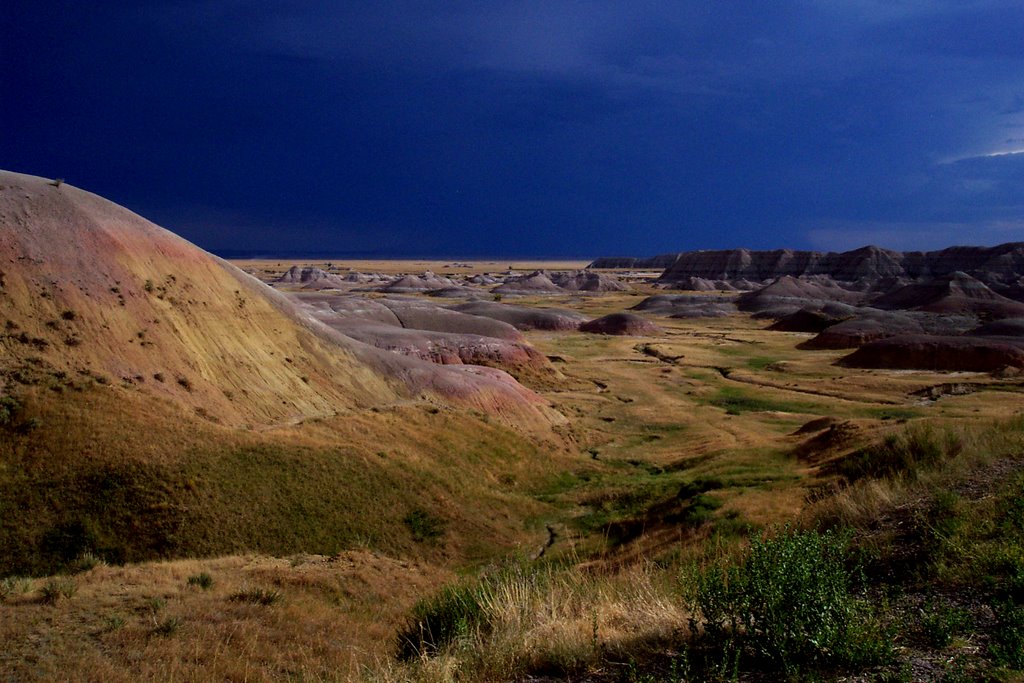 Hidden in the soft clays are fossilized bones of creatures that used to roam the Earth, such as the gigantic-headed Triceratops and three-toed horses that were smaller than Great Danes.
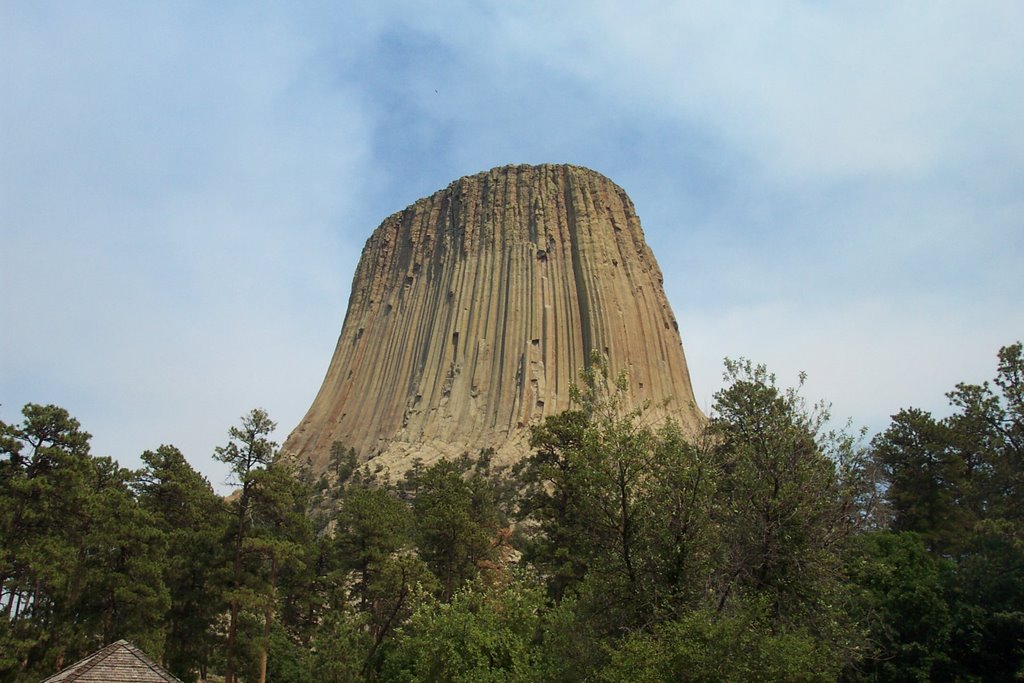
 The granite intrusions of the Black Hills and Devil’s Tower are even older. They are Pre-Cambrian, at least 570 million years old, most likely over a billion years old.
 But some of the oldest rocks I touched were in Sioux Falls, South Dakota. The pink quartzite found there used to be sand 2 billion years ago. Time, tide and great pressure and heat formed the sand into rock. The rock was hidden for billions of years by layers of sediments, and now has been exposed to the elements through erosion.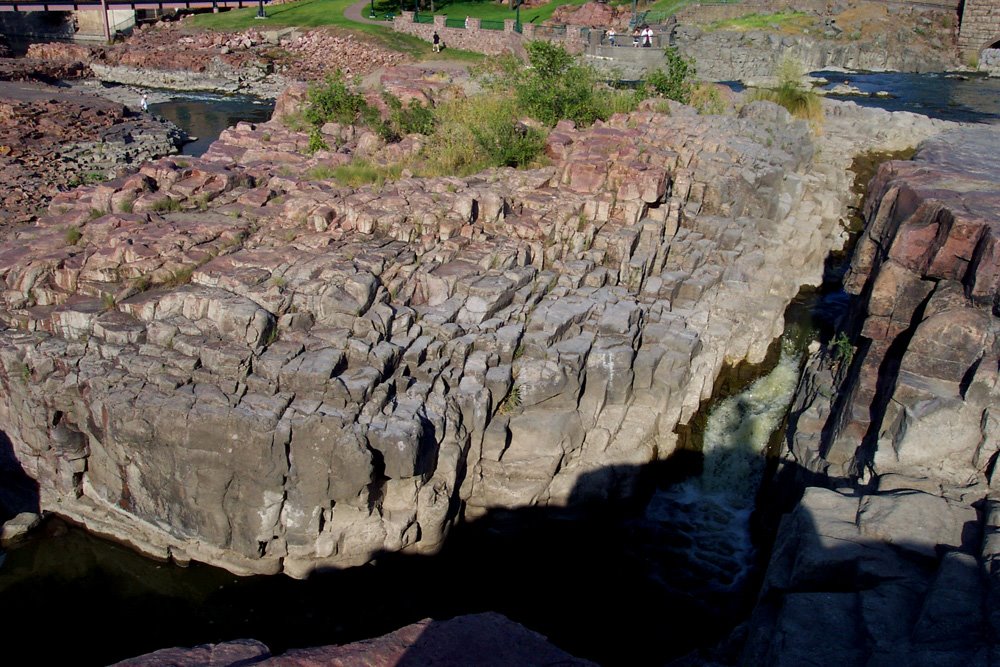
Some of the quartzite ended up in the local roads, giving them a particularly curious deep pink color. Both the quartzite and the gas we were combusting in the mini van have been hidden deep in the earth for ages, but now we’re using these resources up in a matter of decades.
I touched some really old rocks,
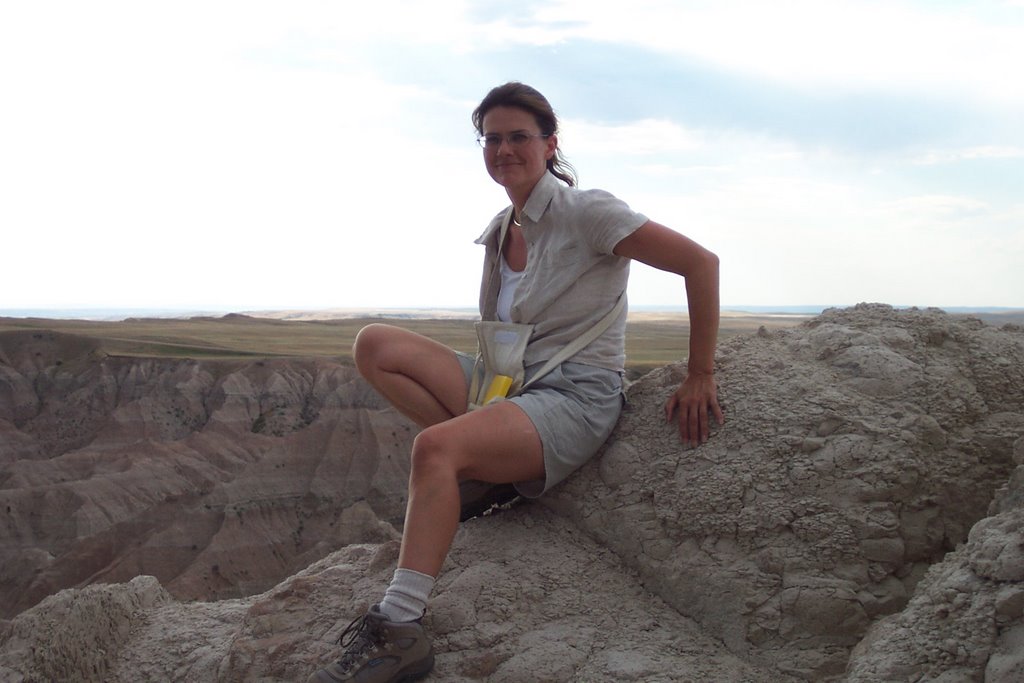 but the Moon showed us the most ancient rocks we can see. I was annoyed at Luna for spilling her light over the night sky all week long. She washed out any chance of seeing a dark star-lit sky. But the 4 billion year old surface of the Moon reminded me of how old things are, and how we are just here briefly, somewhere in a long continuum of time.
The class was taught by Dr. Murray of the University of Michigan at Dearborn. It was an excellent class, and has forever changed the way I look at rocks. And now I don’t feel so old anymore!
Until next week, my friends, enjoy the view.
Saturday, July 08, 2006
Close Knit Stars
7/9/06 – 7/15/06
I love to knit. I learned to knit at Mount Holyoke* College. If you say it fast, it sounds like “Mentally Ill College.” At least that’s what I thought when they called to accept me. I hesitated until I realized who it really was. Mt. Holyoke had a January term, where you could spend a month goofing off, learning to knit, or taking an internship somewhere like Nantucket Island at the Maria* Mitchell Observatory, plotting the light curves of a variable star called DL Cas in the constellation Cassiopeia. I chose the latter. I had already learned to knit watching Moonlighting on Thursday nights with the girls in Ham Hall.
On Nantucket I lived on hot dogs and sauerkraut, shivered along the frozen beaches of a deserted resort island, and studied glass photographic plates of a variable star. The big question I was there to solve: was the “light curve” (its dimming and brightening pattern) of this star changing or remaining stable. Plot after plot, I couldn’t conclude that the light curve was changing. How unsatisfactory. I read my article in the A.A.V.S.O. recently and I didn’t understand half the stuff I wrote. It sounded like a big non-issue.
But it is an issue. Many stars are somewhat variable for a few reasons. Supergiant stars sometimes get brighter and dimmer because they are huge and are shrinking or expanding, trying to survive by “burning” whatever they have left in them after hundreds of millions of years of hydrogen fusion, holding out against the inevitable crushing force of gravity. These are called Cepheid stars, and it has been found that the period of variability of these stars is directly related to how bright they are. Once you find a star’s period, you can figure out its distance by knowing its intrinsic brightness. Thus these stars act as celestial rulers in figuring out distances to objects.
Other stars have different excuses for being variable. Two stars can be knit together with gravity like those mittens held together by a cord. One star might be a medium sized star like the sun, but it might be in orbit with a massive star or a shrunken dwarf star. If it happens that a double star system is at the right angle, we can see the bright star dim for a few hours or even days as the companion star passes in front of it, blocking some of its light.
If you’d like to see a beautiful double star system, find the three stars of the Summer Triangle. The most northwestern star is called Deneb. If you look closely you can trace the shape of a cross, with Deneb at the top. The bottom of the cross is in the middle of the triangle, and is a “star” called Albireo. Through a small telescope, you’ll actually see two stars. One is a brilliant blueish star, and the other actually looks golden. Even though I didn’t go to U of M, I can appreciate the beauty of those two colors next to each other. (Sorry State alums, there are no green stars!) These close knit stars are one of the many beautiful sights to see this summer.
Until next week, my friends, enjoy the view!
(* - pronounced “Whole-Yoke”, and Maria rhymes with pariah. If the representative had pronounced Mt. Holyoke correctly, I wouldn’t have thought the funny farm was calling for me…)
I love to knit. I learned to knit at Mount Holyoke* College. If you say it fast, it sounds like “Mentally Ill College.” At least that’s what I thought when they called to accept me. I hesitated until I realized who it really was. Mt. Holyoke had a January term, where you could spend a month goofing off, learning to knit, or taking an internship somewhere like Nantucket Island at the Maria* Mitchell Observatory, plotting the light curves of a variable star called DL Cas in the constellation Cassiopeia. I chose the latter. I had already learned to knit watching Moonlighting on Thursday nights with the girls in Ham Hall.
On Nantucket I lived on hot dogs and sauerkraut, shivered along the frozen beaches of a deserted resort island, and studied glass photographic plates of a variable star. The big question I was there to solve: was the “light curve” (its dimming and brightening pattern) of this star changing or remaining stable. Plot after plot, I couldn’t conclude that the light curve was changing. How unsatisfactory. I read my article in the A.A.V.S.O. recently and I didn’t understand half the stuff I wrote. It sounded like a big non-issue.
But it is an issue. Many stars are somewhat variable for a few reasons. Supergiant stars sometimes get brighter and dimmer because they are huge and are shrinking or expanding, trying to survive by “burning” whatever they have left in them after hundreds of millions of years of hydrogen fusion, holding out against the inevitable crushing force of gravity. These are called Cepheid stars, and it has been found that the period of variability of these stars is directly related to how bright they are. Once you find a star’s period, you can figure out its distance by knowing its intrinsic brightness. Thus these stars act as celestial rulers in figuring out distances to objects.
Other stars have different excuses for being variable. Two stars can be knit together with gravity like those mittens held together by a cord. One star might be a medium sized star like the sun, but it might be in orbit with a massive star or a shrunken dwarf star. If it happens that a double star system is at the right angle, we can see the bright star dim for a few hours or even days as the companion star passes in front of it, blocking some of its light.
If you’d like to see a beautiful double star system, find the three stars of the Summer Triangle. The most northwestern star is called Deneb. If you look closely you can trace the shape of a cross, with Deneb at the top. The bottom of the cross is in the middle of the triangle, and is a “star” called Albireo. Through a small telescope, you’ll actually see two stars. One is a brilliant blueish star, and the other actually looks golden. Even though I didn’t go to U of M, I can appreciate the beauty of those two colors next to each other. (Sorry State alums, there are no green stars!) These close knit stars are one of the many beautiful sights to see this summer.
Until next week, my friends, enjoy the view!
(* - pronounced “Whole-Yoke”, and Maria rhymes with pariah. If the representative had pronounced Mt. Holyoke correctly, I wouldn’t have thought the funny farm was calling for me…)
Friday, June 30, 2006
Who Cares?
7/2/06 – 7/8/06
By C. Zaitz
My husband and I have a little motorboat called "Who Cares?" We bought it from an older gentleman who was suffering with Alzheimer’s Disease. By the time in life he was ready to sell the boat, his ongoing mantra was, “who cares?” We don’t have the heart to change it. But every time I see “Who Cares?” on the back of the boat, I wonder about that phrase. I suppose he was frustrated at the inevitability of things.
The Ensign Planetarium will be having Summer Astro Camp again this year. The junior camp, for grades k- 4, will go from 9am-12pm July 24-26. For grades 3-10, the camp runs July 31- August 4th. The younger campers will be hearing and seeing Native American stories and explanations of nature, along with our scientific views of how things work. We’ll look at the sky and tell stories and make lots of projects to take home. The second week of camp is all about our solar system, its planets and moons, and some crazy things that happen to them like volcanoes, earthquakes and asteroid collisions. We’ll have fun demonstrations and more great projects to take home.
Sadly, Astro Camp will be the last program here at the Ensign Planetarium. The district is feeling the effects of Michigan’s economy and the lack of support for education that districts all over the state have been feeling for several years now. The loss of my job effects me and my family, but the loss of the Ensign Planetarium affects not only the district, but a far wider community of Metro Detroit and Windsor including pre-k through college students and everyone else who has ever been inspired by the view of something larger and grander than we see on an everyday basis, namely, the Cosmos.
The year 2008 would have marked the 40th year of operation for the planetarium. In 1968, when the planetarium opened, our nation cared very much about finding ways to inspire children to go into math, engineering and space sciences. We were in a fierce race with the Soviet Union to get to the Moon. The National Defense Education Act was passed in 1958 for the direct purpose of aiding schools in their quest toward educating youth, and the money that built this place came from those funds and that quest. We did get to the Moon first, and we have become the most powerful and technological nation on the planet. While that does not guarantee our survival, I do think that inspiring kids to be engineers, scientists, designers and thinkers can only help our nation stay strong. I am sorry that the demise of the Ensign Planetarium is just one event in a continuum of changing values in education. As we homogenize and standardize our children’s education, sometimes we leave out room for creative thought, for different ways of learning, and most importantly, we find we have no room left for the inspirations that lead children to be lifelong learners. In short, we no longer value wonderful, special places like a planetarium.
I would like to thank everyone in the community who has ever come to a show or listened to their kids talk about their trip to the planetarium. I hope that some time in the future the planetarium will once again live and breathe, and inspire future generations to be educated and wonder about their universe. Because I do care, very, very much.
Until next week, my friends, enjoy the view! (And send the wee ones to Astro Camp!)
By C. Zaitz
My husband and I have a little motorboat called "Who Cares?" We bought it from an older gentleman who was suffering with Alzheimer’s Disease. By the time in life he was ready to sell the boat, his ongoing mantra was, “who cares?” We don’t have the heart to change it. But every time I see “Who Cares?” on the back of the boat, I wonder about that phrase. I suppose he was frustrated at the inevitability of things.
The Ensign Planetarium will be having Summer Astro Camp again this year. The junior camp, for grades k- 4, will go from 9am-12pm July 24-26. For grades 3-10, the camp runs July 31- August 4th. The younger campers will be hearing and seeing Native American stories and explanations of nature, along with our scientific views of how things work. We’ll look at the sky and tell stories and make lots of projects to take home. The second week of camp is all about our solar system, its planets and moons, and some crazy things that happen to them like volcanoes, earthquakes and asteroid collisions. We’ll have fun demonstrations and more great projects to take home.
Sadly, Astro Camp will be the last program here at the Ensign Planetarium. The district is feeling the effects of Michigan’s economy and the lack of support for education that districts all over the state have been feeling for several years now. The loss of my job effects me and my family, but the loss of the Ensign Planetarium affects not only the district, but a far wider community of Metro Detroit and Windsor including pre-k through college students and everyone else who has ever been inspired by the view of something larger and grander than we see on an everyday basis, namely, the Cosmos.
The year 2008 would have marked the 40th year of operation for the planetarium. In 1968, when the planetarium opened, our nation cared very much about finding ways to inspire children to go into math, engineering and space sciences. We were in a fierce race with the Soviet Union to get to the Moon. The National Defense Education Act was passed in 1958 for the direct purpose of aiding schools in their quest toward educating youth, and the money that built this place came from those funds and that quest. We did get to the Moon first, and we have become the most powerful and technological nation on the planet. While that does not guarantee our survival, I do think that inspiring kids to be engineers, scientists, designers and thinkers can only help our nation stay strong. I am sorry that the demise of the Ensign Planetarium is just one event in a continuum of changing values in education. As we homogenize and standardize our children’s education, sometimes we leave out room for creative thought, for different ways of learning, and most importantly, we find we have no room left for the inspirations that lead children to be lifelong learners. In short, we no longer value wonderful, special places like a planetarium.
I would like to thank everyone in the community who has ever come to a show or listened to their kids talk about their trip to the planetarium. I hope that some time in the future the planetarium will once again live and breathe, and inspire future generations to be educated and wonder about their universe. Because I do care, very, very much.
Until next week, my friends, enjoy the view! (And send the wee ones to Astro Camp!)
Dive In!
6/25/06 – 7/1/06
by C. Zaitz
We've passed the Summer Solstice, so now it's official. Let the brief Michigan summer begin! Hurry- we've only got about 14 weeks before we have to start bringing in the lawn furniture again. So find a lake and dive in!
People who don't live around the Great Lakes probably don't know that they are like freshwater oceans. You cannot see the other side, as you do in most inland lakes. You can travel for miles and miles and never see a bit of land. They are huge. They can be deep. And you can certainly get lost in them.
I recently bought a snorkeling set from Target. I wanted to see what was at the bottom of the lake. It's like a whole universe I hadn't explored yet. I was very excited to try them out- the mask, the breathing tube, and the flippers for the feet. I'm sure there's a technical term for them, but it amuses me to call them flippers. I had been cautioned by a friend not to put them all on at once, so I started with the mask. Ah!
Have you ever looked through a telescope? The first time you do, if it's aimed at something cool like Saturn or Jupiter, you get little chills and a jolt to the brain. It's really a planet, not just a bright point of light. It's a planet whose features you can see through the miracle of a telescope. When I first saw the Andromeda Galaxy through a small telescope, the idea that I was looking at a galaxy over two million light years from my eye blew me away. That telescope cost $300. The snorkel set cost $30. But I had a similar chill. It's beautiful under water.
I didn't see a single fish, nor any shells, but the sand was beautifully rippled and there were some interesting looking rocks and a Petosky stone. It was no Caribbean dive trip, but just the idea that I could see this underwater universe was a thrill. Then I tried the flippers, and I felt like James Bond sneaking up to the Disco Volante in Thunderball. The last piece was the breathing tube. Hearing myself breathe was another little jolt. How fragile life is.
How fragile indeed. When I looked into the midnight sky later that eve, I remembered the new universe that had opened up to me earlier, and the older, more familiar one that was above. Yet it was so vast and elusive that one could never really know it in a thousand lifetimes. How many sets of eyes have looked at those stars, at those constellations? In how many tongues had people told each other the stories made up in bursts of inspired tale-telling?
Twelve years ago, Jupiter was in the same spot as it is tonight. That is how long it takes the giant planet to orbit its star. When you see it, because you are bound to see it shining brightly in the early evening, think of the giant planet whose girth could engulf over 1300 earths. It holds enough gravity to shepherd 63 moons and counting, but you'll never really appreciate this giant globe of gas until you see it through a telescope. You'll see its largest faithful moons orbiting, and you may even see some stormy features of this incredible planet. Grab a telescope and dive in.
Until next week, my friends, enjoy the view!
by C. Zaitz
We've passed the Summer Solstice, so now it's official. Let the brief Michigan summer begin! Hurry- we've only got about 14 weeks before we have to start bringing in the lawn furniture again. So find a lake and dive in!
People who don't live around the Great Lakes probably don't know that they are like freshwater oceans. You cannot see the other side, as you do in most inland lakes. You can travel for miles and miles and never see a bit of land. They are huge. They can be deep. And you can certainly get lost in them.
I recently bought a snorkeling set from Target. I wanted to see what was at the bottom of the lake. It's like a whole universe I hadn't explored yet. I was very excited to try them out- the mask, the breathing tube, and the flippers for the feet. I'm sure there's a technical term for them, but it amuses me to call them flippers. I had been cautioned by a friend not to put them all on at once, so I started with the mask. Ah!
Have you ever looked through a telescope? The first time you do, if it's aimed at something cool like Saturn or Jupiter, you get little chills and a jolt to the brain. It's really a planet, not just a bright point of light. It's a planet whose features you can see through the miracle of a telescope. When I first saw the Andromeda Galaxy through a small telescope, the idea that I was looking at a galaxy over two million light years from my eye blew me away. That telescope cost $300. The snorkel set cost $30. But I had a similar chill. It's beautiful under water.
I didn't see a single fish, nor any shells, but the sand was beautifully rippled and there were some interesting looking rocks and a Petosky stone. It was no Caribbean dive trip, but just the idea that I could see this underwater universe was a thrill. Then I tried the flippers, and I felt like James Bond sneaking up to the Disco Volante in Thunderball. The last piece was the breathing tube. Hearing myself breathe was another little jolt. How fragile life is.
How fragile indeed. When I looked into the midnight sky later that eve, I remembered the new universe that had opened up to me earlier, and the older, more familiar one that was above. Yet it was so vast and elusive that one could never really know it in a thousand lifetimes. How many sets of eyes have looked at those stars, at those constellations? In how many tongues had people told each other the stories made up in bursts of inspired tale-telling?
Twelve years ago, Jupiter was in the same spot as it is tonight. That is how long it takes the giant planet to orbit its star. When you see it, because you are bound to see it shining brightly in the early evening, think of the giant planet whose girth could engulf over 1300 earths. It holds enough gravity to shepherd 63 moons and counting, but you'll never really appreciate this giant globe of gas until you see it through a telescope. You'll see its largest faithful moons orbiting, and you may even see some stormy features of this incredible planet. Grab a telescope and dive in.
Until next week, my friends, enjoy the view!
The Great Dying
6/18/06 – 6/24/06
by C. Zaitz
Some scientists would rather look down at the ground rather than up at the sky. I’ve never been one to dwell among the dust and rocks, but lately I’ve grown an appreciation for the science of dirt. Here’s why.
Sometimes the sky comes down to earth. A crater found near the Yucatan Peninsula of Mexico indicates that a 6 mile wide asteroid or comet hit the earth about 65 million years ago, and not long after, lots of plants and animals died. This was the K-T extinction (Cretaceous (K) and Tertiary (T) periods of geologic history), where about 75% of the world’s species were snuffed out, including the poster-critters of the time, the Dinosaurs.
But there was an even worse extinction in the distant past. About 250 million years ago, nearly 90% of all life on earth was extinguished by some mechanism. The so-called “Great Dying” is also known as the Permian -Triassic (P -T) extinction. When 90% of all life on earth dies, scientists want to know why. Until now, there was no smoking gun, other than the usual suspects of volcanism, plate tectonics, changing climate, etc.
The latest news in “astro-geology” is that the location of the impact of a giant asteroid has just been found. Now we see the smoking gun, and it looks like the bullet was about 30 miles wide! Unfortunately the gun isn’t really smoking anymore- it has had 250 million years to cool. The crater left by the impact is hard to see. Over hundreds of millions of years, the ocean floor has subducted (slid underneath a continent). New ocean floor is created by the upwelling of lava. Therefore, not much of the original impact is left. A 300 mile wide land mass was discovered in East Antarctica by measuring the difference in gravity from one spot to another. Scientists overlaid radar maps of the area and the huge land mass fit inside a circular ridge. There are other suspects, however; massive volcanic eruptions also took place around the P-T boundary. But now geologists can compare and contrast these major extinctions and the factors that may have caused them. It’s pretty safe to say that when giant rocks fall from the sky, things go badly here on earth.
In July I will be heading west to study geology with a small group of college students. We will drive to Wisconsin, South Dakota, and Wyoming: The Badlands, The Black Hills, and Mt. Rushmore. I will be able to see the actual K-T boundary. It’s a visible line in the rocks. There is a high amount of the element iridium in this layer. High amounts of iridium indicate asteroid collision, since normal rocks from earth don’t have as much. Finding high levels of iridium is another smoking gun in the killer-asteroid scenario, and makes a good case for finding ways to prevent space rocks from hitting the earth in the future.
Knowing that rock-scientists don’t have much time to look up, I have elected myself “official night sky guide.” I’m anticipating dark skies so I’m brushing up on the harder-to-find constellations. Maybe we’ll see some meteors. I’ve heard that when you’re out in the wilderness, you can almost hear them burn up. I hope they do burn up. I’ll dig into the earth to see the rocks from space, but I don’t want to be under one when it hits!
Until next week, my friends, enjoy the view!
by C. Zaitz
Some scientists would rather look down at the ground rather than up at the sky. I’ve never been one to dwell among the dust and rocks, but lately I’ve grown an appreciation for the science of dirt. Here’s why.
Sometimes the sky comes down to earth. A crater found near the Yucatan Peninsula of Mexico indicates that a 6 mile wide asteroid or comet hit the earth about 65 million years ago, and not long after, lots of plants and animals died. This was the K-T extinction (Cretaceous (K) and Tertiary (T) periods of geologic history), where about 75% of the world’s species were snuffed out, including the poster-critters of the time, the Dinosaurs.
But there was an even worse extinction in the distant past. About 250 million years ago, nearly 90% of all life on earth was extinguished by some mechanism. The so-called “Great Dying” is also known as the Permian -Triassic (P -T) extinction. When 90% of all life on earth dies, scientists want to know why. Until now, there was no smoking gun, other than the usual suspects of volcanism, plate tectonics, changing climate, etc.
The latest news in “astro-geology” is that the location of the impact of a giant asteroid has just been found. Now we see the smoking gun, and it looks like the bullet was about 30 miles wide! Unfortunately the gun isn’t really smoking anymore- it has had 250 million years to cool. The crater left by the impact is hard to see. Over hundreds of millions of years, the ocean floor has subducted (slid underneath a continent). New ocean floor is created by the upwelling of lava. Therefore, not much of the original impact is left. A 300 mile wide land mass was discovered in East Antarctica by measuring the difference in gravity from one spot to another. Scientists overlaid radar maps of the area and the huge land mass fit inside a circular ridge. There are other suspects, however; massive volcanic eruptions also took place around the P-T boundary. But now geologists can compare and contrast these major extinctions and the factors that may have caused them. It’s pretty safe to say that when giant rocks fall from the sky, things go badly here on earth.
In July I will be heading west to study geology with a small group of college students. We will drive to Wisconsin, South Dakota, and Wyoming: The Badlands, The Black Hills, and Mt. Rushmore. I will be able to see the actual K-T boundary. It’s a visible line in the rocks. There is a high amount of the element iridium in this layer. High amounts of iridium indicate asteroid collision, since normal rocks from earth don’t have as much. Finding high levels of iridium is another smoking gun in the killer-asteroid scenario, and makes a good case for finding ways to prevent space rocks from hitting the earth in the future.
Knowing that rock-scientists don’t have much time to look up, I have elected myself “official night sky guide.” I’m anticipating dark skies so I’m brushing up on the harder-to-find constellations. Maybe we’ll see some meteors. I’ve heard that when you’re out in the wilderness, you can almost hear them burn up. I hope they do burn up. I’ll dig into the earth to see the rocks from space, but I don’t want to be under one when it hits!
Until next week, my friends, enjoy the view!
Dead Reckoning
6/11/06 – 6/17/06
C. Zaitz
When I was a teenager I read the entire series of books by C. S. Forester about a 19th century British naval adventurer named Horatio Hornblower. In one story, Horatio had to go for his lieutenant exam and was cramming all the necessary navigation mathematics and trigonometry in his head. Unfortunately, he froze during the examination and was failing. As he stammered out his response, he caught a glimpse of a fire ship- a wooden ship set intentionally on fire to destroy other wooden ships. On instinct he abandoned the exam and valiantly dove into the water, swam to the fiery ship, climbed aboard and steered it to safety, away from the British fleet lying helpless in the harbor. He eventually did make it to lieutenant, and even Admiral, some 10 volumes later.
I have since learned more of the complex navigation about which Horatio was examined. Finding latitude has always been a snap, as long as you can see the North Star, Polaris and have a sextant or angle measuring device handy. It happens that the altitude of Polaris in the sky is equal to your latitude on earth. That is because Polaris lies almost directly over the north pole of the earth. You can prove this to be true with a diagram and a little knowledge of trigonometry. In Dearborn Heights, the height of Polaris in the sky is about 42.3 degrees, and we know that our latitude is 42.3 N. You can get out your sextant tonight and check it out!
However, finding one’s longitude at sea was never an easy feat. To find it you must find the time of your local noon, or when the sun crosses your meridian, and compare it to Greenwich Mean Time. Of course, if you don’t have a watch or a cell phone, neither of which Horatio had, this is difficult. Before the invention of an accurate chronometer in the 1750s, sailors used a technique called Dead Reckoning to find their positions. It was basically a process of extrapolation. If you know how far you’ve gone since your last accurate position, or at least know how fast you’ve traveled and in what direction, you can figure out where you are now or will be in the future. Of course you must correct for wind and waves and human error along the way. Is it any wonder that Columbus’ voyage was a bit hairy?
Nowadays we use satellites in space to accurately find our positions, whether we are out on a boat in Lake Huron or driving from The Heights to Livonia. The Global Positioning System, developed and maintained by the US Department of Defense, uses more than two dozen satellites to send radio signals to anyone with a GPS receiver.
Modern day navigators often use old and new methods to maintain their courses. It’s always handy to have a working knowledge of at least ten or so bright stars in the night sky. All three stars of the summer triangle are considered navigational stars. Planets like Jupiter, though they are bright and easy to find, are not used for navigation, since their position changes noticeably over the course of weeks and months. You can watch Jupiter in Libra all summer, however. His large distance from the sun makes him appear to move slowly in the sky. We can enjoy his bright glow until mid August.
Until next week, my friends, enjoy the view!
C. Zaitz
When I was a teenager I read the entire series of books by C. S. Forester about a 19th century British naval adventurer named Horatio Hornblower. In one story, Horatio had to go for his lieutenant exam and was cramming all the necessary navigation mathematics and trigonometry in his head. Unfortunately, he froze during the examination and was failing. As he stammered out his response, he caught a glimpse of a fire ship- a wooden ship set intentionally on fire to destroy other wooden ships. On instinct he abandoned the exam and valiantly dove into the water, swam to the fiery ship, climbed aboard and steered it to safety, away from the British fleet lying helpless in the harbor. He eventually did make it to lieutenant, and even Admiral, some 10 volumes later.
I have since learned more of the complex navigation about which Horatio was examined. Finding latitude has always been a snap, as long as you can see the North Star, Polaris and have a sextant or angle measuring device handy. It happens that the altitude of Polaris in the sky is equal to your latitude on earth. That is because Polaris lies almost directly over the north pole of the earth. You can prove this to be true with a diagram and a little knowledge of trigonometry. In Dearborn Heights, the height of Polaris in the sky is about 42.3 degrees, and we know that our latitude is 42.3 N. You can get out your sextant tonight and check it out!
However, finding one’s longitude at sea was never an easy feat. To find it you must find the time of your local noon, or when the sun crosses your meridian, and compare it to Greenwich Mean Time. Of course, if you don’t have a watch or a cell phone, neither of which Horatio had, this is difficult. Before the invention of an accurate chronometer in the 1750s, sailors used a technique called Dead Reckoning to find their positions. It was basically a process of extrapolation. If you know how far you’ve gone since your last accurate position, or at least know how fast you’ve traveled and in what direction, you can figure out where you are now or will be in the future. Of course you must correct for wind and waves and human error along the way. Is it any wonder that Columbus’ voyage was a bit hairy?
Nowadays we use satellites in space to accurately find our positions, whether we are out on a boat in Lake Huron or driving from The Heights to Livonia. The Global Positioning System, developed and maintained by the US Department of Defense, uses more than two dozen satellites to send radio signals to anyone with a GPS receiver.
Modern day navigators often use old and new methods to maintain their courses. It’s always handy to have a working knowledge of at least ten or so bright stars in the night sky. All three stars of the summer triangle are considered navigational stars. Planets like Jupiter, though they are bright and easy to find, are not used for navigation, since their position changes noticeably over the course of weeks and months. You can watch Jupiter in Libra all summer, however. His large distance from the sun makes him appear to move slowly in the sky. We can enjoy his bright glow until mid August.
Until next week, my friends, enjoy the view!
Expecting the Unexpected
6/4/06 – 6/10/06
by C. Zaitz
Have you ever had those nights when you wake up for no apparent reason? I had one the other night, though I have my suspicions about certain pets helping me to consciousness. Once I was up, I wandered outside. The stars were magnificent. I sighed out a breath in awe. The Milky Way sparkled overhead, framed by the three bright stars of the Summer Triangle. Arcturus shone its bright orange light to the west.
I’ve seen this scene a hundred times before. Ever since I learned to recognize the constellations, I’ve known the summer sky. So what drew me out at 3 am to see it? It was the prospect of seeing something I hadn’t seen before. There’s so much to look at; the more you stare, the more you see. The summer sky is much richer than the sky at any other season because we are looking into the heart of the galaxy. Since we are about two thirds of the way from the center of the galaxy, we see the majority of stars as we look in toward the middle. They are so far away, however, that they look like a creamy, blurry swipe of light across the sky. There is also a lot of dust between stars which obscures part of the Milky Way, like dark islands in a sparkling river.
The more you look at the summer sky, the more your eyes play tricks on you. Sometimes I catch a streak of light out of the corner of my eye. Meteors are always an unexpected treat, especially when you happen to be looking at the right part of the sky to see them. The dazzling light is actually plasma, or hot glowing gas, created by the intense friction of falling space dust. The sun is made of plasma, as is lightning. Flames are not. Plasma is much hotter than a campfire; the stuff over which you toast your marshmallows is not in the same league as a plasma trail left by a meteor. It’s the plasma that allows a speck of dust from outer space to catch our eye.
Sometimes the steady motion of a satellite captures my attention as it tumbles across the sky. Invariably, I imagine that at any moment something completely bizarre and alien will come spiraling out of the heavens and prove once and for all that we are not alone. On any given night there are thousands of telescopes aimed at many places in the sky. If the galaxy was teaming with life, we probably would have seen it by now. I imagine aliens would be busily commuting from star to star, but we see no such traffic. Maybe the aliens are sneaky. Maybe they don't have lights on their spaceships.
So far I’ve never seen anything unusual or spooky, but the chance that it could happen, that some flying spaceship or spectacular fire ball could reveal itself to me, keeps me scanning the skies. I’m expecting the unexpected. That’s what draws me out at 3 am, and always has.
We may never find a flying saucer or glimpse an alien up close, but it never hurts to look, and you can watch Jupiter drift across your field of view all night long. If you see Venus in the East, you’ve stayed up all night and it’s time to go make the coffee.
Until next week, my friends, enjoy the view!
by C. Zaitz
Have you ever had those nights when you wake up for no apparent reason? I had one the other night, though I have my suspicions about certain pets helping me to consciousness. Once I was up, I wandered outside. The stars were magnificent. I sighed out a breath in awe. The Milky Way sparkled overhead, framed by the three bright stars of the Summer Triangle. Arcturus shone its bright orange light to the west.
I’ve seen this scene a hundred times before. Ever since I learned to recognize the constellations, I’ve known the summer sky. So what drew me out at 3 am to see it? It was the prospect of seeing something I hadn’t seen before. There’s so much to look at; the more you stare, the more you see. The summer sky is much richer than the sky at any other season because we are looking into the heart of the galaxy. Since we are about two thirds of the way from the center of the galaxy, we see the majority of stars as we look in toward the middle. They are so far away, however, that they look like a creamy, blurry swipe of light across the sky. There is also a lot of dust between stars which obscures part of the Milky Way, like dark islands in a sparkling river.
The more you look at the summer sky, the more your eyes play tricks on you. Sometimes I catch a streak of light out of the corner of my eye. Meteors are always an unexpected treat, especially when you happen to be looking at the right part of the sky to see them. The dazzling light is actually plasma, or hot glowing gas, created by the intense friction of falling space dust. The sun is made of plasma, as is lightning. Flames are not. Plasma is much hotter than a campfire; the stuff over which you toast your marshmallows is not in the same league as a plasma trail left by a meteor. It’s the plasma that allows a speck of dust from outer space to catch our eye.
Sometimes the steady motion of a satellite captures my attention as it tumbles across the sky. Invariably, I imagine that at any moment something completely bizarre and alien will come spiraling out of the heavens and prove once and for all that we are not alone. On any given night there are thousands of telescopes aimed at many places in the sky. If the galaxy was teaming with life, we probably would have seen it by now. I imagine aliens would be busily commuting from star to star, but we see no such traffic. Maybe the aliens are sneaky. Maybe they don't have lights on their spaceships.
So far I’ve never seen anything unusual or spooky, but the chance that it could happen, that some flying spaceship or spectacular fire ball could reveal itself to me, keeps me scanning the skies. I’m expecting the unexpected. That’s what draws me out at 3 am, and always has.
We may never find a flying saucer or glimpse an alien up close, but it never hurts to look, and you can watch Jupiter drift across your field of view all night long. If you see Venus in the East, you’ve stayed up all night and it’s time to go make the coffee.
Until next week, my friends, enjoy the view!
Musings
5/28/06 – 6/3/06
by C. Zaitz
It’s hard to believe that the end of the school year is here. Graduation is upon us, and I’ll have to say goodbye and good luck to many graduating seniors I’ve known since I became the director of the Ensign Planetarium in 2001. Watching them grow and mature from the fun and silly freshman they were to the fun and more thoughtful young adults they are now has been an inspiration to me. I will miss them, but it is a joyous parting as they go explore their worlds and spread their wings. I wish my budding pilot, pastry cook, teacher, engineer etc. much luck and I hope their inspirations grow with their aspirations.
We all have muses- things or people that inspire us. My lovely sophomore friend Jaidaa inspired me to write about good people that come and go in our lives. Billy Joel wrote, “So many people in and out of your life, some will last, some will just be now and then. Life is a series of hellos and goodbyes, I’m afraid it’s time for goodbye again.”
Five years ago Mr. Richard Ensign said goodbye to the planetarium he helped build and take care of for over three decades. He had earned his retirement through years of hard work and passion that he puts into everything he does. I am inspired by him and I am glad to welcome him back on June 7th at 7pm to talk about his favorite things. I’d like to invite the community to come to the Ensign Planetarium in Crestwood High School that night to be inspired by him yourself. I’d also like to invite the community to support your planetarium so that we may continue to educate and inspire future generations of pilots and cooks and teachers and engineers.
In Greek mythology, the Muses had the task of inspiring humanity in the arts and sciences. Urania is the Muse of Astronomy, but also of Astrology and Universal Love. She was also known as a philosopher, and directed men's thoughts skyward, to loftier regions. She is sometimes depicted wearing a billowing blue dress tied with a broad sash covered in constellations. Urania’s name means “heavenly one.” Her name is related to the name of the god of the sky, Ouranos, or heaven, from which the name of the constellation Orion may also be derived. I think it’s interesting that the Muse of Astronomy is also the Muse of Universal Love, because when I look at the sky it makes me breathless with its vast beauty. I think of our planet and of everybody living on it as a connected, beautiful community. I guess it inspires a kind of universal love. Even as we come and go in each other’s lives, there is an ongoing connection between us. Goodbye is just a delayed response to hello, and vice versa.
Meanwhile, the time between goodbye and hello of the sun is getting very short, so we have to stay up late to see the daring duo of Mars and Saturn before they set in the west. Jupiter is up all night, but only early birds will catch a glimpse of the goddess of love, Venus. She’ll be basking in the lovely sunrise as you look out your east facing window.
Until next week, my friends, enjoy the view!
by C. Zaitz
It’s hard to believe that the end of the school year is here. Graduation is upon us, and I’ll have to say goodbye and good luck to many graduating seniors I’ve known since I became the director of the Ensign Planetarium in 2001. Watching them grow and mature from the fun and silly freshman they were to the fun and more thoughtful young adults they are now has been an inspiration to me. I will miss them, but it is a joyous parting as they go explore their worlds and spread their wings. I wish my budding pilot, pastry cook, teacher, engineer etc. much luck and I hope their inspirations grow with their aspirations.
We all have muses- things or people that inspire us. My lovely sophomore friend Jaidaa inspired me to write about good people that come and go in our lives. Billy Joel wrote, “So many people in and out of your life, some will last, some will just be now and then. Life is a series of hellos and goodbyes, I’m afraid it’s time for goodbye again.”
Five years ago Mr. Richard Ensign said goodbye to the planetarium he helped build and take care of for over three decades. He had earned his retirement through years of hard work and passion that he puts into everything he does. I am inspired by him and I am glad to welcome him back on June 7th at 7pm to talk about his favorite things. I’d like to invite the community to come to the Ensign Planetarium in Crestwood High School that night to be inspired by him yourself. I’d also like to invite the community to support your planetarium so that we may continue to educate and inspire future generations of pilots and cooks and teachers and engineers.
In Greek mythology, the Muses had the task of inspiring humanity in the arts and sciences. Urania is the Muse of Astronomy, but also of Astrology and Universal Love. She was also known as a philosopher, and directed men's thoughts skyward, to loftier regions. She is sometimes depicted wearing a billowing blue dress tied with a broad sash covered in constellations. Urania’s name means “heavenly one.” Her name is related to the name of the god of the sky, Ouranos, or heaven, from which the name of the constellation Orion may also be derived. I think it’s interesting that the Muse of Astronomy is also the Muse of Universal Love, because when I look at the sky it makes me breathless with its vast beauty. I think of our planet and of everybody living on it as a connected, beautiful community. I guess it inspires a kind of universal love. Even as we come and go in each other’s lives, there is an ongoing connection between us. Goodbye is just a delayed response to hello, and vice versa.
Meanwhile, the time between goodbye and hello of the sun is getting very short, so we have to stay up late to see the daring duo of Mars and Saturn before they set in the west. Jupiter is up all night, but only early birds will catch a glimpse of the goddess of love, Venus. She’ll be basking in the lovely sunrise as you look out your east facing window.
Until next week, my friends, enjoy the view!
Rubble Piles
5/21/06 – 5/27/06
by C. Zaitz
I was in the hospital waiting for my husband to have his one-inch kidney stone removed when I saw a show about near Earth asteroids and the threat they pose to us. There are lots of asteroids out there in uncomfortably close orbits to Earth. Some of these miles-wide mountains could annihilate life on Earth if they collided with us. But not all asteroids are whole. Some are collections of smaller rocks held together by their flimsy gravity. It turns out that these are the most dangerous threats to us because of the difficulty of destroying or deflecting them.
I thought of the giant stone in my husband’s kidney. Doctors slid a tube into his kidney, used directed energy to break the stone up, collected the pulverized bits into a net and pulled it out of him. Those little fragments would have caused more pain passing in a few days than the whole stone had caused sitting in his kidney for the past few years. Then I thought about those rubble pile asteroids. They are like garage-sized buckshot and would possibly do even more damage than a lone asteroid. How can we prevent such a collection of rocks from hitting the Earth? We don’t have anything in place to deal with such a threat – no rockets ready to go explode or deflect the asteroids, and certainly no nets to collect the pieces of any giant rubble piles heading toward us.
The truth is that we haven’t even located all the near earth asteroids. So far only 60% of them have been mapped, and even known asteroids can change orbit or character. Over the past few weeks, astronomers have watched comet 73P/Schwassmann-Wachmann 3 disintegrate into more than 30 fragments as it flew by some 6 million miles from us. That’s about 30 times the distance from the Earth to the Moon. It was not a threat, but astronomers are convinced it’s a matter of time before another very large asteroid or comet finds us. I say “another” because it has happened in the past. The giant meteor crater in Arizona is proof that a falling rock can make a big hole in the Earth. About one hundred tons of interplanetary material fall onto the Earth on a daily basis.
It’s enough to give you the willies. NASA does have NEO, its Near Earth Object program. According to NASA’s website, http://neo.jpl.nasa.gov/, NASA has five different programs concentrating on looking for NEOs, and Japan and Italy are also keeping an eye on the sky. I didn’t get a warm cozy feeling from their website since they do not address any capability of stopping NEOs that might impact the Earth. Necessity is the mother of invention, and there has been no immediate threat to spur the invention of Earth-protecting programs. However, if we are to have a chance at destroying or deflecting large Earth-bound boulders in space, early detection and action is the key. I hope we don’t wait until we are between a rock and a hard place, excuse the pun.
If these thoughts keep you awake at night, you can pass the time by watching for lovely Venus and the thin waning crescent Moon before dawn on the 24th. After sunset you can find Mars, Saturn and Jupiter spangled across the sky from west to east.
Until next week, my friends, enjoy the view!
by C. Zaitz
I was in the hospital waiting for my husband to have his one-inch kidney stone removed when I saw a show about near Earth asteroids and the threat they pose to us. There are lots of asteroids out there in uncomfortably close orbits to Earth. Some of these miles-wide mountains could annihilate life on Earth if they collided with us. But not all asteroids are whole. Some are collections of smaller rocks held together by their flimsy gravity. It turns out that these are the most dangerous threats to us because of the difficulty of destroying or deflecting them.
I thought of the giant stone in my husband’s kidney. Doctors slid a tube into his kidney, used directed energy to break the stone up, collected the pulverized bits into a net and pulled it out of him. Those little fragments would have caused more pain passing in a few days than the whole stone had caused sitting in his kidney for the past few years. Then I thought about those rubble pile asteroids. They are like garage-sized buckshot and would possibly do even more damage than a lone asteroid. How can we prevent such a collection of rocks from hitting the Earth? We don’t have anything in place to deal with such a threat – no rockets ready to go explode or deflect the asteroids, and certainly no nets to collect the pieces of any giant rubble piles heading toward us.
The truth is that we haven’t even located all the near earth asteroids. So far only 60% of them have been mapped, and even known asteroids can change orbit or character. Over the past few weeks, astronomers have watched comet 73P/Schwassmann-Wachmann 3 disintegrate into more than 30 fragments as it flew by some 6 million miles from us. That’s about 30 times the distance from the Earth to the Moon. It was not a threat, but astronomers are convinced it’s a matter of time before another very large asteroid or comet finds us. I say “another” because it has happened in the past. The giant meteor crater in Arizona is proof that a falling rock can make a big hole in the Earth. About one hundred tons of interplanetary material fall onto the Earth on a daily basis.
It’s enough to give you the willies. NASA does have NEO, its Near Earth Object program. According to NASA’s website, http://neo.jpl.nasa.gov/, NASA has five different programs concentrating on looking for NEOs, and Japan and Italy are also keeping an eye on the sky. I didn’t get a warm cozy feeling from their website since they do not address any capability of stopping NEOs that might impact the Earth. Necessity is the mother of invention, and there has been no immediate threat to spur the invention of Earth-protecting programs. However, if we are to have a chance at destroying or deflecting large Earth-bound boulders in space, early detection and action is the key. I hope we don’t wait until we are between a rock and a hard place, excuse the pun.
If these thoughts keep you awake at night, you can pass the time by watching for lovely Venus and the thin waning crescent Moon before dawn on the 24th. After sunset you can find Mars, Saturn and Jupiter spangled across the sky from west to east.
Until next week, my friends, enjoy the view!
Why is the Sky Dark at Night?
5/14/06 – 5/20/06
by C. Zaitz
Technically, the sky it isn’t all that dark, especially in the Metro Detroit area. But let’s think about that glorious silky black sky we remember from our summers up North or some other dark place we’ve been. These are rare places where city lights are so scarce that you can see the hazy arms of our Milky Way Galaxy. The haze represents hundreds of millions of stars, but they are so distant and numerous they appear to cut a luminescent swath across the summer sky.
If you tear your gaze away from that beauty, you will find other parts of the sky that can look quite dark and devoid of stars. How can this be? You might wonder how there could be any dark places in the night sky if there are an infinite number of stars in an infinite universe. Since the time of Kepler people have wondered about this seeming paradox; if there are an infinite number of stars in the sky, then no matter where you look, even out to infinity, eventually you should see the surface of a star. It’s called Olbers’ Paradox.
As stated, the paradox is true. If there are an infinite number of stars, then the entire sky should be lit up as bright as the surface of the sun by their combined light. But perhaps they are not distributed evenly throughout the universe. We know they collect into spirals and blobs known as galaxies. But even so, the infinite number of galaxies should fill up every degree of sky we can see. So why is the night sky dark?
The answer has to do with the fact that universe is expanding, and that it isn’t infinitely old. That really means that it’s not infinite after all. Astronomers have figured out that the observable universe is about 13.7 billion years old. We can’t see anything that might lie beyond a radius of 13.7 billion light years away because the light just hasn’t had time to reach us yet.
The universe is also expanding. The light we get from very distant galaxies is dimmer than light from closer galaxies due to something called their redshift. Their light has traveled so far in something that is expanding on the way (space) that by the time it reaches us it’s pretty tired and weak (shifted toward the red end of the spectrum). The ultimate evidence of this is the Cosmic Background Radiation we find in everywhere in the universe. It is the radiation created in the Big Bang, but it is so weak and redshifted after traveling through expanding space that it is nearly invisible to us in any wavelength.
These are very short (incomplete) explanations to a question which is actually quite deep and somewhat interesting, so if you’d like to know more of the science behind Olbers’ Paradox, you can check out this website: http://en.wikipedia.org/wiki/Olbers'_paradox or Google “Olbers’ Paradox.” Meanwhile you can always enjoy the glorious rays of the planets shining down from east to west as the night progresses. Mars and Saturn chase the sun down to the northwestern horizon at sunset, and beautiful, radiant Venus entices the sun up in the northeast at sunrise, but steady, royal Jupiter, King of the Planets, stays out all night long.
Until next week, my friends, enjoy the view!
Ich Spreche Kein Deutsch

5/7/06 – 5/13/06
By C. Zaitz
I usually pick up at least a FEW phrases of the language when I travel, but I couldn’t even get out “excuse me!” in German. “Entschuldigen Sie!” By the time I got my mouth wrapped around the syllables, the moment had passed. In Italian it’s “scusi” and can be said right on the spot, without preparation.
Perhaps “I speak no German” as the title indicates, but the beauty of a thin waxing moon needs no words. In Bebra, Germany overlooking a lovely view of rolling hills, sheep and the first night sky I've seen here, it is stunning. I've been waiting for a clear night so I could see the sky in this tiny little town tucked in the folds of Deutschland’s hilly terrain. I've experienced nearly every type of weather so far; der regen (rain), die wolke (cloud), der schnee (snow), der blitz (lightning), and even der hagel (hail). But no stern, mond, nor planet (star, moon or planet). I know why the german word for weather is “wetter.”
My clearest view of the sky was on the plane. At 39,000 feet I saw Jupiter so bright and bold he looked like a brilliant diamond. I saw Scorpius, Orion’s nemesis, stretched out luxuriously along the southern sky, and the teapot shape of Sagittarius the Archer right behind. As we flew into Frankfurt the morning sky was peach and rose and the tops of the clouds were glowing orange, with Jupiter beginning to wink goodnight in the west. It was the loveliest sight I've seen in a long time.
I sat next to an experienced pilot who was just shuttling back after an overseas flight. I asked him if he had ever seen anything strange in the sky. He said that pilots see things all the time, but they don't talk about it. He'd seen a fast-flying light once that he couldn’t explain. I asked him if pilots in general knew the stars or constellations, or were aware what planets they could see. He didn't think so. He didn’t know that the brightest “star” in view was really Jupiter. I was surprised, but I just assume other folks are as curious about the sky as I am. I spend a great deal of time looking at the sky compared to many people because of my job, but pilots must have to stare at the sky most of their working hours! He said the newer planes have big windows and when he flew across the North Pole he would see the northern lights. I was envious. I wanted to be a pilot after talking to him just for the perks- the great view of the sky!
My last evening in Bebra was pretty; the beautiful moon shone near Mars and Saturn, aglow in the orange-fringed azure sky. A few bright stars were scattered above high cirrus clouds as I had my usual repast of bread/beer, a cheese product, and coffee. (Being a vegetarian in the land of Bratwurst is not easy; every town sounded like a kind of hot dog.) But as I flew out of Frankfurt and began to get my six hours of earth's rotation back, I was happy to be above the clouds again.
It may seem funny to return from a wonderful trip to a foreign land and talk mostly about the flight there and back, but that is indeed where my view of the sky was best. And that’s where I learned the German word for “flying speed” – Reisegeschwindigkeit!
Until next week, my friends, enjoy the view!


The Alternator
4/30/06 –5/6/06
By C. Zaitz
My grandma just turned 90 and I drove to NY to help celebrate. I had a lovely time with family, but it was a short visit and a 7 hour rainy, gloomy, and otherwise dreary drive back across Canada to Michigan. I noticed when I slowed down the battery light came on in my car. Yikes. But when I sped up it disappeared. Hmm.
I was halfway through Canada when it got dark. Was I just tired or were my headlights flickering?
60 km from the Ambassador Bridge, I noticed the windshield wipers slowing and the console and head lights dimming. Hours before, my spider sense had told me to shut off the radio, giving me plenty of quiet time to listen to the symphony of knocks and pings from my aging Sunfire. Every few minutes I heard a “thwap” from under the hood. I told myself it was just the wind, but I knew something was afoot.
Around 10pm I saw a star; a brilliant blue-white star twinkling and snapping in an otherwise black and gloomy sky. I knew it had to be Sirius; no other star would be so bold on a night such as this. I was glad to see Sirius. I thought it meant that the rain would end and I wouldn’t have to use the battery-draining wipers anymore. No such luck. A convoy of semi trucks roared by me flinging greasy road spew onto my windshield. Sirius disappeared, rain squalls started, the wipers wiped furiously, and within 15 minutes the car was completely dead. I sat there contemplating things while sitting in a little truck pull-off. One kind truck driver looked under my hood, but we agreed there was little to be done. It was the alternator. So while I waited for the tow truck, I scanned the clearing skies over Windsor, Ontario, Canada.
It was well after 11pm and Sirius had already set, but Procyon twinkled at me instead. Procyon is the brightest star in Canis Minor, the Little Dog. The Gemini twins appeared nearby as did Saturn, and then I caught a glimpse of Regulus, the brightest star in Leo the Lion. Now there is an amazing star- it’s nearly 4 times bigger than the sun but it spins once every 16 hours. It spins so fast it’s flattened out like an egg. If it spun only 16% faster it would tear itself to shreds.
I thought about that as I sat in my little car. It was a dwarf among the giant trucks at the little pit stop and I felt rather nervous at times, but Jupiter crept up behind me from the east and made me smile when I saw him. He looked very bold and confident.
My knight in shining tow truck eventually arrived, took my car to a garage to await the morning, and very kindly chauffeured me to a motel where I did the same. The sky was once again socked in with clouds, but I am forever grateful for the comfort of the clear moments when I saw my old friends. And I’m also grateful to all the folks who are out there at the dead of night helping out other folks who need assistance.
The sun came out the next morning, the alternator was replaced and I crossed the Ambassador Bridge, happy to be back home. Now I journey to Germany but I will be back with more adventures, hopefully of a jollier nature.
Until next week, my friends, enjoy the view!
By C. Zaitz
My grandma just turned 90 and I drove to NY to help celebrate. I had a lovely time with family, but it was a short visit and a 7 hour rainy, gloomy, and otherwise dreary drive back across Canada to Michigan. I noticed when I slowed down the battery light came on in my car. Yikes. But when I sped up it disappeared. Hmm.
I was halfway through Canada when it got dark. Was I just tired or were my headlights flickering?
60 km from the Ambassador Bridge, I noticed the windshield wipers slowing and the console and head lights dimming. Hours before, my spider sense had told me to shut off the radio, giving me plenty of quiet time to listen to the symphony of knocks and pings from my aging Sunfire. Every few minutes I heard a “thwap” from under the hood. I told myself it was just the wind, but I knew something was afoot.
Around 10pm I saw a star; a brilliant blue-white star twinkling and snapping in an otherwise black and gloomy sky. I knew it had to be Sirius; no other star would be so bold on a night such as this. I was glad to see Sirius. I thought it meant that the rain would end and I wouldn’t have to use the battery-draining wipers anymore. No such luck. A convoy of semi trucks roared by me flinging greasy road spew onto my windshield. Sirius disappeared, rain squalls started, the wipers wiped furiously, and within 15 minutes the car was completely dead. I sat there contemplating things while sitting in a little truck pull-off. One kind truck driver looked under my hood, but we agreed there was little to be done. It was the alternator. So while I waited for the tow truck, I scanned the clearing skies over Windsor, Ontario, Canada.
It was well after 11pm and Sirius had already set, but Procyon twinkled at me instead. Procyon is the brightest star in Canis Minor, the Little Dog. The Gemini twins appeared nearby as did Saturn, and then I caught a glimpse of Regulus, the brightest star in Leo the Lion. Now there is an amazing star- it’s nearly 4 times bigger than the sun but it spins once every 16 hours. It spins so fast it’s flattened out like an egg. If it spun only 16% faster it would tear itself to shreds.
I thought about that as I sat in my little car. It was a dwarf among the giant trucks at the little pit stop and I felt rather nervous at times, but Jupiter crept up behind me from the east and made me smile when I saw him. He looked very bold and confident.
My knight in shining tow truck eventually arrived, took my car to a garage to await the morning, and very kindly chauffeured me to a motel where I did the same. The sky was once again socked in with clouds, but I am forever grateful for the comfort of the clear moments when I saw my old friends. And I’m also grateful to all the folks who are out there at the dead of night helping out other folks who need assistance.
The sun came out the next morning, the alternator was replaced and I crossed the Ambassador Bridge, happy to be back home. Now I journey to Germany but I will be back with more adventures, hopefully of a jollier nature.
Until next week, my friends, enjoy the view!
Subscribe to:
Posts (Atom)