12/31/06 – 1/6/06
by C. Zaitz
I’ve been thinking about time. I celebrated Christmas with my parents in Adams Basin, New York. Adams Basin is a little cross roads, but it has a tiny Post Office, a church, and a Little Red Schoolhouse. It is also recognized as the place where George Washington’s drummer boy was buried. In 1976 I was a little Brownie Girl Scout, marching in the Bicentennial parade, when America celebrated 200 years as a nation. We stopped at the little hill cemetery where the crooked slabs of marble poked out of the ground like broken teeth. People who had lived so long ago were buried there, their names long since erased by rain and wind. I grew up in an old house where the land was rich with buried bottles of different colors and shapes that would turn up every spring after roto-tilling. Every time we’d find a bottle, it was an exciting link to the past and the history of the little burg.
This past year I have learned a lot about time and different ways to think about it. Geology has taught me that time can be read like a mystery novel. Rock and dirt layers write the past in paragraphs of time, with overlapping plots and buried clues, like my bottles. Astronomy often depicts time as an arrow. The point of the arrow is in your brain, and the feathers are at the object whose light you are seeing. Locally, time’s arrow is straight and true, traveling only in one direction, from past to present to future. The Second Law of Thermodynamics is an expression of how we all feel about time- it tends to flow, like heat or energy, from concentrated to spread out, like light leaving the sun.
However, we have found that gravity and speed can change time, as Einstein’s Theory of General Relativity has stated. Traveling at nearly the speed of light can really slow down time for you. So can getting too close to the gravity of a black hole. If you were standing at a distance watching someone “fall in” to a black hole, they would appear to slow down and stop right at the edge, and you’d never actually see them fall in due to the stretching of time. Apparently time can be touched, time can be changed. Time is perceived.
My education courses reminded me that time must be used wisely, as teachers have a lot of work to do in a short period of time. Organization and planning must be the tools of an effective teacher, or an effective person. In this case, time is a commodity, and we are always trying to buy more. Sometimes we all need a mini black hole to slow down time for us.
On a personal note, this year has been one full of changes for me, from job loss to full time school and training, and now I will begin student teaching. I am grateful to those of you who have expressed support for the work I do in astronomy outreach, both by writing and by teaching in the planetarium. It is the one thing I hold on to through all the changes, and if I could keep the warm feelings I get from sharing astronomy in a bottle, I would, but since the only way to really “keep” moments of time is to share them, I will continue to do so as long as I can.
Until next week, my friends, enjoy the view.
Wednesday, December 27, 2006


Tuesday, December 19, 2006
Circle of Stars
12/24/06 – 12/30/06
by C.Zaitz
What a lovely time of year to see the stars. It’s always been said that winter stargazing is the best stargazing of all. The sky is dark right after dinner, and is lazy to get bright again the next morning, giving us the longest nights of the year. With our mild winter so far, it’s not such a task to spend a few minutes looking heaven-ward.
What’s up there to see? Looking south, you’ll see the “wreath” - seven stars that form a ring in the winter sky. Some call it the “winter circle.” It’s so sparkly bright, I like to think of it as a wreath of candles sparkling all night long. Four of these seven stars are in the top ten list of bright stars of all time.
Let’s start with the Bull’s eye. Though it’s only the 13th brightest in the sky, it’s a noticeable star. Aldebaran is the name of the pink-tinged eye of Taurus, the Bull. Since we’re starting our circle with this star, let’s be sure we know which one it is. Use the three stars of Orion’s belt, from east to west, to make an arrow that points up to it. It’s the top star of a V-shape of stars, outlining the face of Taurus. From there, you can look back at Orion’s foot, a bright blue-white star called Rigel, from the Arabic ar-rijl, “the foot.” That’s one hot foot! Rigel is much hotter than our own sun, and the 7th brightest in the sky. Now we are going clockwise around the circle, and the next stop is the most serious one of all. It’s Sirius, the number one brightest star in the whole night sky. Sirius is also nick-named “the dog star” due to its position as the wet, shiny nose of Canis Major, the big dog. Now we are east of Orion, and can look up from Sirius to another bright star in a dog constellation. This time it’s the little dog, Canis Minor. The star’s name is Procyon, which means “before the dog” referring to the fact that Procyon rises slightly before Sirius, the dog star. It’s the 8th brightest star in the sky.
We are halfway around, and the next two stars are the Twins. Castor and Pollux, the twin boys of the god Zeus disguised as a swan, and Leda. The two stars are inseparable, just as the twins were during their life, so the stories go. At the top of the circle is a bright star called Capella. It’s very high up in the sky, and it is the 6th brightest star in the sky. Its name means “she-goat.” It is part of a constellation named “Auriga” which sounds a little like Orion, who is just below him. Auriga is a Charioteer, but he is holding baby goats in his arms, known as “the kids.” They are a cute little triangle of faint stars near Capella, who must then be the Momma goat.
And then there’s the famous star Betelgeuse, though it lies more toward the middle of the circle. It is the 10th brightest star in the sky. As the shoulder (or more literally, “armpit”) of Orion, it shouldn’t be forgotten in our winter stargazing.
I hope you enjoy the embracing wreath of winter stars, as you enjoy the embraces of family and friends this holiday. Joy and peace to you all!
Until next week, my friends, enjoy the view.
Here's a website with a good depiction of the Winter Circle.
by C.Zaitz
What a lovely time of year to see the stars. It’s always been said that winter stargazing is the best stargazing of all. The sky is dark right after dinner, and is lazy to get bright again the next morning, giving us the longest nights of the year. With our mild winter so far, it’s not such a task to spend a few minutes looking heaven-ward.
What’s up there to see? Looking south, you’ll see the “wreath” - seven stars that form a ring in the winter sky. Some call it the “winter circle.” It’s so sparkly bright, I like to think of it as a wreath of candles sparkling all night long. Four of these seven stars are in the top ten list of bright stars of all time.
Let’s start with the Bull’s eye. Though it’s only the 13th brightest in the sky, it’s a noticeable star. Aldebaran is the name of the pink-tinged eye of Taurus, the Bull. Since we’re starting our circle with this star, let’s be sure we know which one it is. Use the three stars of Orion’s belt, from east to west, to make an arrow that points up to it. It’s the top star of a V-shape of stars, outlining the face of Taurus. From there, you can look back at Orion’s foot, a bright blue-white star called Rigel, from the Arabic ar-rijl, “the foot.” That’s one hot foot! Rigel is much hotter than our own sun, and the 7th brightest in the sky. Now we are going clockwise around the circle, and the next stop is the most serious one of all. It’s Sirius, the number one brightest star in the whole night sky. Sirius is also nick-named “the dog star” due to its position as the wet, shiny nose of Canis Major, the big dog. Now we are east of Orion, and can look up from Sirius to another bright star in a dog constellation. This time it’s the little dog, Canis Minor. The star’s name is Procyon, which means “before the dog” referring to the fact that Procyon rises slightly before Sirius, the dog star. It’s the 8th brightest star in the sky.
We are halfway around, and the next two stars are the Twins. Castor and Pollux, the twin boys of the god Zeus disguised as a swan, and Leda. The two stars are inseparable, just as the twins were during their life, so the stories go. At the top of the circle is a bright star called Capella. It’s very high up in the sky, and it is the 6th brightest star in the sky. Its name means “she-goat.” It is part of a constellation named “Auriga” which sounds a little like Orion, who is just below him. Auriga is a Charioteer, but he is holding baby goats in his arms, known as “the kids.” They are a cute little triangle of faint stars near Capella, who must then be the Momma goat.
And then there’s the famous star Betelgeuse, though it lies more toward the middle of the circle. It is the 10th brightest star in the sky. As the shoulder (or more literally, “armpit”) of Orion, it shouldn’t be forgotten in our winter stargazing.
I hope you enjoy the embracing wreath of winter stars, as you enjoy the embraces of family and friends this holiday. Joy and peace to you all!
Until next week, my friends, enjoy the view.
Here's a website with a good depiction of the Winter Circle.
Wednesday, December 13, 2006
Light of the World
12/17/06 – 12/23/06
by C. Zaitz
I’ll admit it right now, I think I’m in the throes of SAD, the seasonal affect disorder, or at the very least, I’m pining after sunlight. Usually I love to see all the lights and decorations at this time of year. I have strings of “stars” hanging in my porch, twinkling on and off, and my neighbors have decorated with strings and strings of colored lights, wicker light-covered deer that appear to graze, and those blow-up Santas and snow-globe scenes. Perhaps I’ve grown cynical, but sometimes it all seems like too much.
Light can be good, but too much of anything can be bad. We live in a place where bigger seems to be better, where we want more of everything. I have a neighbor who has pretty much covered every square inch of her front yard with some glowing bit of plastic or twinkling light. Sure, it makes your mouth gape, but a little of the surprise and wonder is tinged with horror, as we remember the energy dials clicking and our hard earned money flying right up to the sky. So this year, I’m wondering if we can all spend a moment or two thinking about the ways we can avoid wasting resources. At the risk of sounding like Scrooge crossed with the Grinch, I wish we could tone down the outer displays and work on our inner lights, spreading around cheer and goodwill in a more personal way.
That’s a tall order, especially for someone like me who is pining for cheer and light. But think of the benefits of being able to walk out on your front porch with your kids and point to the Pleiades, that beautiful little cluster of stars that hangs on the edge of visibility in our light polluted skies. Or to be able to see Polaris, the North Star, and talk about who might be standing under the North Star at this time of year, working hard for all the good little girls and boys. Polaris is not a very bright star, and can be washed out by our street lights. It is the end star of the Little Dipper, but most of the stars of the Little Dipper are also washed out by light pollution.
I’m not suggesting we turn off all our lights; that would be sad. But perhaps we can resist the urge to “outdo” our neighbors and find other ways to show our Christmas spirit. Here’s something you can share with your neighbors as you are coming in from your long days of working, shopping, and surviving. See if you can find Orion’s belt in the sky, use a finger to draw a line up from the lowest star, straight across the three stars and beyond, until you find another bright star in a V-shaped group. This star is named Aldebaran. It’s the eye of Taurus, the Bull. On Taurus’ back ride the Pleiades (usually pronounced PLEE-a-dees), the little cluster of stars I mentioned. If you have a pair of binoculars, take the time to look through them. I predict you will be delighted. They are prettier than any diamonds in the jewelry store, and they have a lot of history and mythology associated with them. Sharing that with your family can be priceless!
I wish you all a very merry and cheery holiday season, with or without lights, but mostly I wish you peace and happiness.
Until next week, my friends, enjoy the view.
by C. Zaitz
I’ll admit it right now, I think I’m in the throes of SAD, the seasonal affect disorder, or at the very least, I’m pining after sunlight. Usually I love to see all the lights and decorations at this time of year. I have strings of “stars” hanging in my porch, twinkling on and off, and my neighbors have decorated with strings and strings of colored lights, wicker light-covered deer that appear to graze, and those blow-up Santas and snow-globe scenes. Perhaps I’ve grown cynical, but sometimes it all seems like too much.
Light can be good, but too much of anything can be bad. We live in a place where bigger seems to be better, where we want more of everything. I have a neighbor who has pretty much covered every square inch of her front yard with some glowing bit of plastic or twinkling light. Sure, it makes your mouth gape, but a little of the surprise and wonder is tinged with horror, as we remember the energy dials clicking and our hard earned money flying right up to the sky. So this year, I’m wondering if we can all spend a moment or two thinking about the ways we can avoid wasting resources. At the risk of sounding like Scrooge crossed with the Grinch, I wish we could tone down the outer displays and work on our inner lights, spreading around cheer and goodwill in a more personal way.
That’s a tall order, especially for someone like me who is pining for cheer and light. But think of the benefits of being able to walk out on your front porch with your kids and point to the Pleiades, that beautiful little cluster of stars that hangs on the edge of visibility in our light polluted skies. Or to be able to see Polaris, the North Star, and talk about who might be standing under the North Star at this time of year, working hard for all the good little girls and boys. Polaris is not a very bright star, and can be washed out by our street lights. It is the end star of the Little Dipper, but most of the stars of the Little Dipper are also washed out by light pollution.
I’m not suggesting we turn off all our lights; that would be sad. But perhaps we can resist the urge to “outdo” our neighbors and find other ways to show our Christmas spirit. Here’s something you can share with your neighbors as you are coming in from your long days of working, shopping, and surviving. See if you can find Orion’s belt in the sky, use a finger to draw a line up from the lowest star, straight across the three stars and beyond, until you find another bright star in a V-shaped group. This star is named Aldebaran. It’s the eye of Taurus, the Bull. On Taurus’ back ride the Pleiades (usually pronounced PLEE-a-dees), the little cluster of stars I mentioned. If you have a pair of binoculars, take the time to look through them. I predict you will be delighted. They are prettier than any diamonds in the jewelry store, and they have a lot of history and mythology associated with them. Sharing that with your family can be priceless!
I wish you all a very merry and cheery holiday season, with or without lights, but mostly I wish you peace and happiness.
Until next week, my friends, enjoy the view.
Wednesday, December 06, 2006
The Elusive Green Stars
12/10/06 – 12/16/06
by C. Zaitz
Stars come in different colors. We’ve all heard about “red giants” and “white dwarfs”, blue hot stars and orange cool stars. But what about green stars? Where are all the green stars? Our streets and houses are lit up this time of year with lights of red, blue, purple, green, orange and yellow. The stars come in those colors too, all but green. So what’s wrong with green stars?
Green is a great color. It's my mom’s favorite color, so I usually buy her clothes with green in them to make her happy. Green is the color of life, of plants and trees. Grass bleeds green when you cut it, and to me the color even "smells" like freshly cut grass. Green is the color of ”go” and avocados, girl scouts and money. Green is great. But not in stars. Our sun radiates energy mostly in the green part of the spectrum, so technically it would be a green star, if stars could look green. But they can’t. Why not?
Remember Roy G. Biv? Scientists have done away with color indigo for the most part, so it could be shortened to Roy Gbv, but that’s not as memorable, and hard to pronounce. Roy is the red end of the spectrum, and Biv is the blue end. Green is right in the middle of the light spectrum, and that is the problem. We can easily see when a star’s energy peaks in the red end of the spectrum. Most of the light we can see is reddish, so these cooler stars often appear red, even to the naked eye. The star Betelgeuse in the right shoulder of Orion is a classic red giant star. Very hot stars can peak in the blue end of the spectrum, giving them a bluish-white cast. The star diagonal from Betelgeuse in Orion’s left foot is called Rigel, and it is a very large, hot, bluish star. When you compare the tint of these two stars in the sky, it’s pretty easy to see the difference. However, since green is smack dab in the middle of the spectrum, when a star sends out most of its radiation in that wavelength, it is also sending out almost as much in the adjacent wavelengths. So all the colors- the reds, greens and blues- all mix together and make white. If we looked at our sun from above the atmosphere it would look white. In the sky it often appears yellow, or even red near the horizon. This is not because the sun has changed color. It is because the air is scattering blue light to make the sky blue, and the color that’s left when you take light blue out of white is yellow. Later on, as the light from the sun has to pass through a lot of atmosphere at sunset, most of the blue light has been scattered out of the sunlight, and only the long reddish wavelengths are left, giving us really rich sunsets.
If you want to see pretty Betelgeuse and bright Rigel, wait a little while after sunset, and you will see the three bright stars of Orion’s Belt. They are, from east to west, Alnitak, Alnilam, and Mintaka. Betelgeuse is above Alnitak, and Rigel is below Mintaka. All three stars in the belt are white-blue stars, very hot and very big. You can look for a green star among the thousands up there, but unless you’re wearing green-tinted glasses, you won’t find one!
Until next week, my friends, enjoy the view.
by C. Zaitz
Stars come in different colors. We’ve all heard about “red giants” and “white dwarfs”, blue hot stars and orange cool stars. But what about green stars? Where are all the green stars? Our streets and houses are lit up this time of year with lights of red, blue, purple, green, orange and yellow. The stars come in those colors too, all but green. So what’s wrong with green stars?
Green is a great color. It's my mom’s favorite color, so I usually buy her clothes with green in them to make her happy. Green is the color of life, of plants and trees. Grass bleeds green when you cut it, and to me the color even "smells" like freshly cut grass. Green is the color of ”go” and avocados, girl scouts and money. Green is great. But not in stars. Our sun radiates energy mostly in the green part of the spectrum, so technically it would be a green star, if stars could look green. But they can’t. Why not?
Remember Roy G. Biv? Scientists have done away with color indigo for the most part, so it could be shortened to Roy Gbv, but that’s not as memorable, and hard to pronounce. Roy is the red end of the spectrum, and Biv is the blue end. Green is right in the middle of the light spectrum, and that is the problem. We can easily see when a star’s energy peaks in the red end of the spectrum. Most of the light we can see is reddish, so these cooler stars often appear red, even to the naked eye. The star Betelgeuse in the right shoulder of Orion is a classic red giant star. Very hot stars can peak in the blue end of the spectrum, giving them a bluish-white cast. The star diagonal from Betelgeuse in Orion’s left foot is called Rigel, and it is a very large, hot, bluish star. When you compare the tint of these two stars in the sky, it’s pretty easy to see the difference. However, since green is smack dab in the middle of the spectrum, when a star sends out most of its radiation in that wavelength, it is also sending out almost as much in the adjacent wavelengths. So all the colors- the reds, greens and blues- all mix together and make white. If we looked at our sun from above the atmosphere it would look white. In the sky it often appears yellow, or even red near the horizon. This is not because the sun has changed color. It is because the air is scattering blue light to make the sky blue, and the color that’s left when you take light blue out of white is yellow. Later on, as the light from the sun has to pass through a lot of atmosphere at sunset, most of the blue light has been scattered out of the sunlight, and only the long reddish wavelengths are left, giving us really rich sunsets.
If you want to see pretty Betelgeuse and bright Rigel, wait a little while after sunset, and you will see the three bright stars of Orion’s Belt. They are, from east to west, Alnitak, Alnilam, and Mintaka. Betelgeuse is above Alnitak, and Rigel is below Mintaka. All three stars in the belt are white-blue stars, very hot and very big. You can look for a green star among the thousands up there, but unless you’re wearing green-tinted glasses, you won’t find one!
Until next week, my friends, enjoy the view.
Wednesday, November 29, 2006
What's on the Radio?
12/3/06 – 12/9/06
by C. Zaitz
We’ve all seen the dish. They have popped up like mushrooms all over the place. Even colleges and universities have them. However, some dishes that look like TV satellite dishes may actually be radio telescopes. They collect radio waves from the universe. I know that sounds funny, as if you could hear the universe on your radio, but I should clarify. Radio waves are very different from the sounds coming from your radio.
When we point big dishes up to the sky, even a satellite TV dish, we are collecting electromagnetic radiation in the form of radio waves. These are very long waves that can pass through our bodies without as much as a tingle. One wave can be as long as a city block, or as short as your shoe size. The radio station you listen to has to change electronic signals into carrier waves, which travel through the air. When these waves, which are flying all over the place harmlessly, get to the tuner in your radio, they are changed back into a signal that is amplified and modified. These signals produce vibrations on a speaker in your radio. It’s the sound pressure waves from the speaker going in and out quickly that reach your ear and your brain interprets as Mozart or Green Day. Pretty cool.
Sound waves cannot travel in space, since they need a medium (air) to vibrate in order to travel. The beauty of radio waves is that all they need is the original energy source that set them off. They can travel from one end of the universe to the other. Sure, they’ll lose some energy if they travel a long way, but we can still collect them if we have a big enough dish. That’s why we build giant radio dishes. One of the most famous ones was built in an old meteor crater in Arecibo, Puerto Rico. Nature hollowed out a big hole for us, and we stuck a dish in it and collect radio waves from all sorts of interesting objects.
Another cool thing about radio waves is that they can penetrate clouds and dust. Many other wavelengths, like much of the infrared and ultraviolet waves, as well as gamma and X-rays, are blocked by our atmosphere. But radio waves can go through clouds, even clouds of dust in space. Light can’t do that, so our picture of the universe in radio waves can sometimes be clearer than optical images. So what do we look at in radio waves?
The sun is a great producer of radio waves. In radio wavelengths, we see sunspots and solar flares that we might not see in visible light. Beyond the sun, there are stars and galaxies that produce radio waves. In fact, some objects emit more energy in radio waves than in light, so radio astronomy has opened up a new window on the universe. Galaxies that emitted strongly in the radio spectrum were the first clues to finding black holes and quasars. The Cosmic Background Radiation, the lynchpin in the theory of the Big Bang, was discovered by radio technology back in the 1960’s. Radio astronomy is still going strong today, and since radio dishes are relatively inexpensive and easy to build, even some schools and amateur astronomy clubs have them. So the next time your hear about a radio telescope, you’ll know that they are looking at, not listening to, the universe!
Until next week, my friends, enjoy the view.
by C. Zaitz
We’ve all seen the dish. They have popped up like mushrooms all over the place. Even colleges and universities have them. However, some dishes that look like TV satellite dishes may actually be radio telescopes. They collect radio waves from the universe. I know that sounds funny, as if you could hear the universe on your radio, but I should clarify. Radio waves are very different from the sounds coming from your radio.
When we point big dishes up to the sky, even a satellite TV dish, we are collecting electromagnetic radiation in the form of radio waves. These are very long waves that can pass through our bodies without as much as a tingle. One wave can be as long as a city block, or as short as your shoe size. The radio station you listen to has to change electronic signals into carrier waves, which travel through the air. When these waves, which are flying all over the place harmlessly, get to the tuner in your radio, they are changed back into a signal that is amplified and modified. These signals produce vibrations on a speaker in your radio. It’s the sound pressure waves from the speaker going in and out quickly that reach your ear and your brain interprets as Mozart or Green Day. Pretty cool.
Sound waves cannot travel in space, since they need a medium (air) to vibrate in order to travel. The beauty of radio waves is that all they need is the original energy source that set them off. They can travel from one end of the universe to the other. Sure, they’ll lose some energy if they travel a long way, but we can still collect them if we have a big enough dish. That’s why we build giant radio dishes. One of the most famous ones was built in an old meteor crater in Arecibo, Puerto Rico. Nature hollowed out a big hole for us, and we stuck a dish in it and collect radio waves from all sorts of interesting objects.
Another cool thing about radio waves is that they can penetrate clouds and dust. Many other wavelengths, like much of the infrared and ultraviolet waves, as well as gamma and X-rays, are blocked by our atmosphere. But radio waves can go through clouds, even clouds of dust in space. Light can’t do that, so our picture of the universe in radio waves can sometimes be clearer than optical images. So what do we look at in radio waves?
The sun is a great producer of radio waves. In radio wavelengths, we see sunspots and solar flares that we might not see in visible light. Beyond the sun, there are stars and galaxies that produce radio waves. In fact, some objects emit more energy in radio waves than in light, so radio astronomy has opened up a new window on the universe. Galaxies that emitted strongly in the radio spectrum were the first clues to finding black holes and quasars. The Cosmic Background Radiation, the lynchpin in the theory of the Big Bang, was discovered by radio technology back in the 1960’s. Radio astronomy is still going strong today, and since radio dishes are relatively inexpensive and easy to build, even some schools and amateur astronomy clubs have them. So the next time your hear about a radio telescope, you’ll know that they are looking at, not listening to, the universe!
Until next week, my friends, enjoy the view.
Wednesday, November 22, 2006
How’s the Weather?
11/26/06 – 12/2/06
by C. Zaitz
It’s the time of year when people start wondering about El Nino and what kind of winter we’re going to have. When I was younger, I would roll my eyes when my parents would ask, "how's the weather." Now, because I’m six hours due west of them, it’s fun to see how long it takes our weather to get to Rochester, New York. Weather tends to move from northwest to east in the United States. What Canada brings us, we send along to them, with a little Ontario “lake effect snow” for excitement.
If we lived on the western side of Michigan, we’d get lake effect snow as well. ”Lake effect” happens as air moves over a large body of water and picks up warmth and water vapor. As the air moves onto land, it cools off. Cooler air can’t hold as much humidity as warmer air, so it precipitates out and falls as snow. Our weather in Metro Detroit has to cross the whole Michigan Mitten before it reaches us, and by then it’s had time to dry out. Our snow fall is much more reasonable than snowfall in Traverse City, since it’s the lee shore of the lakes that gets the brunt of lake effect snow, sometimes spectacularly. I remember some awesome snowstorms and school closings growing up.
Nowadays there’s talk about El Nino. Simply put, it’s a combination of ocean and air changes that effect climate in a far-reaching area. If the Pacific Ocean has a higher than normal near-surface temperature for an extended period of time, it causes climate changes not only across North America, but around the globe. The combination of the warmer ocean along with changes it produces in air currents cause circulation to change, trade winds to alter, and weather reflects the changes.
The west coast may get more rain, and the Midwest can be drier during an El Nino period. But in Michigan, we get a milder winter. I’m not complaining. By now you’ve probably guessed I’m not a fan of snow, storms, or clouds. After growing up with lake effect snow and bad sinuses, I long for hot, dry and sunny. I’d be happy if I never had to blow my nose again. But it seems with El Nino and the effects of global warming, Michigan just might be the place to be. Folks in California may be under water, along with the east coast. The Midwest will be on fire, but in Michigan, we’re sitting pretty. Michigan may be the new Georgia.
I don’t mean to make light of a serious situation, but the more we learn about the earth’s climate systems, the more we should be ready for changes. We have already seen rising global temperatures over the past decade, and carbon dioxide levels in the atmosphere currently surpass any we’ve seen in the last 650,000 years. If a lot of volcanoes happen to erupt in the next decades, we’re sunk! It won’t be a giant asteroid that does us in, it will be our proclivity for spouting CO2 into the air. Google “Venus” if you want to see what happens next.
Speaking of Venus, she’s going to make her return to the evening twilight in December, so keep your eyes peeled for her bright orb to appear near the sunset as the month wears on.
Until next week, my friends, enjoy the view.
by C. Zaitz
It’s the time of year when people start wondering about El Nino and what kind of winter we’re going to have. When I was younger, I would roll my eyes when my parents would ask, "how's the weather." Now, because I’m six hours due west of them, it’s fun to see how long it takes our weather to get to Rochester, New York. Weather tends to move from northwest to east in the United States. What Canada brings us, we send along to them, with a little Ontario “lake effect snow” for excitement.
If we lived on the western side of Michigan, we’d get lake effect snow as well. ”Lake effect” happens as air moves over a large body of water and picks up warmth and water vapor. As the air moves onto land, it cools off. Cooler air can’t hold as much humidity as warmer air, so it precipitates out and falls as snow. Our weather in Metro Detroit has to cross the whole Michigan Mitten before it reaches us, and by then it’s had time to dry out. Our snow fall is much more reasonable than snowfall in Traverse City, since it’s the lee shore of the lakes that gets the brunt of lake effect snow, sometimes spectacularly. I remember some awesome snowstorms and school closings growing up.
Nowadays there’s talk about El Nino. Simply put, it’s a combination of ocean and air changes that effect climate in a far-reaching area. If the Pacific Ocean has a higher than normal near-surface temperature for an extended period of time, it causes climate changes not only across North America, but around the globe. The combination of the warmer ocean along with changes it produces in air currents cause circulation to change, trade winds to alter, and weather reflects the changes.
The west coast may get more rain, and the Midwest can be drier during an El Nino period. But in Michigan, we get a milder winter. I’m not complaining. By now you’ve probably guessed I’m not a fan of snow, storms, or clouds. After growing up with lake effect snow and bad sinuses, I long for hot, dry and sunny. I’d be happy if I never had to blow my nose again. But it seems with El Nino and the effects of global warming, Michigan just might be the place to be. Folks in California may be under water, along with the east coast. The Midwest will be on fire, but in Michigan, we’re sitting pretty. Michigan may be the new Georgia.
I don’t mean to make light of a serious situation, but the more we learn about the earth’s climate systems, the more we should be ready for changes. We have already seen rising global temperatures over the past decade, and carbon dioxide levels in the atmosphere currently surpass any we’ve seen in the last 650,000 years. If a lot of volcanoes happen to erupt in the next decades, we’re sunk! It won’t be a giant asteroid that does us in, it will be our proclivity for spouting CO2 into the air. Google “Venus” if you want to see what happens next.
Speaking of Venus, she’s going to make her return to the evening twilight in December, so keep your eyes peeled for her bright orb to appear near the sunset as the month wears on.
Until next week, my friends, enjoy the view.
Wednesday, November 15, 2006
In the Twinkle of a Star
11/19/06 – 11/26/06
by C. Zaitz
Have you ever wondered why the stars twinkle? We all know the song by heart, but it never really tells us why they twinkle, twinkle. The song wonders what they are, the little twinkling stars. I don’t want to ruin the song for anyone, but there are answers to both questions.
We don’t have to go very far to study a star. There’s one about 8 minutes away (going at the speed of light, of course). Traveling 70 mph, it would take us 1,328,571 hours, or 55,357 days, or 152 years!
Luckily we don’t have to go there. We can collect information from the sun just by standing outside with a telescope or other device to collect its light. The information we gather tells us the story of the Sun. It’s a middle-aged star, fusing hydrogen atoms in its core to produce enough energy and light to keep its planets warm and cozy. Well, not all its planets, just the lucky closer ones.
All stars are giant collections of atoms, mostly hydrogen. Stars are so mammoth that the great pressures near their centers allow for normally repulsive forces to be overcome and for atoms to fuse into new elements like oxygen and carbon. In fact, without the stars’ atom-fusing abilities, we’d have been a pretty boring universe of hydrogen and helium with a sprinkling of lithium for spice. No mercury, gold or silver. They came later, from stars.
So when you look up at the stars, you can think of them as giant element-producing ovens, getting very hot from churning out planet-making elements like silicon and nitrogen, stuff that ends up as sand and air. Think of that next time you’re on the beach, looking at the pretty sunset. It all came from some star, ancestor to our own sun.
While we’re at the beach, we can also figure out why stars twinkle. Just look into the water. See how the pebbles on the bottom seem to jump and hop around as the waves wash over them? The water is the medium that the light must travel through to get to our eyes. Light likes to go straight in a vacuum, but will change speed or direction in thicker stuff, like air or water, especially if they are moving. The water at the beach is moving a lot, so the pebbles seem to jump around madly. The air is also moving and therefore “bending” light, but not as much, since it is much less dense than water.
However, there is much more air above us than below us. There is a veritable ocean of air above us, and we must look through this “ocean” to see the stars. The starlight may have been traveling in the vacuum of space for millions of years, steady and true, all the way to earth. But when it gets to our atmosphere, it gets jostled, nudged and pushed around by moving air currents. By the time we get to see it, starlight can be jumping around like a drop of water on a hot frying pan. In winter, the atmosphere is often more turbulent, so you will see lots of twinkling and winking of starlight. It’s annoying in a telescope, but can be very pretty to the naked eye. So while you’re humming the song, you can enjoy the very distant stars twinkling and making someone a new beach!
Until next week, my friends, enjoy the view.
by C. Zaitz
Have you ever wondered why the stars twinkle? We all know the song by heart, but it never really tells us why they twinkle, twinkle. The song wonders what they are, the little twinkling stars. I don’t want to ruin the song for anyone, but there are answers to both questions.
We don’t have to go very far to study a star. There’s one about 8 minutes away (going at the speed of light, of course). Traveling 70 mph, it would take us 1,328,571 hours, or 55,357 days, or 152 years!
Luckily we don’t have to go there. We can collect information from the sun just by standing outside with a telescope or other device to collect its light. The information we gather tells us the story of the Sun. It’s a middle-aged star, fusing hydrogen atoms in its core to produce enough energy and light to keep its planets warm and cozy. Well, not all its planets, just the lucky closer ones.
All stars are giant collections of atoms, mostly hydrogen. Stars are so mammoth that the great pressures near their centers allow for normally repulsive forces to be overcome and for atoms to fuse into new elements like oxygen and carbon. In fact, without the stars’ atom-fusing abilities, we’d have been a pretty boring universe of hydrogen and helium with a sprinkling of lithium for spice. No mercury, gold or silver. They came later, from stars.
So when you look up at the stars, you can think of them as giant element-producing ovens, getting very hot from churning out planet-making elements like silicon and nitrogen, stuff that ends up as sand and air. Think of that next time you’re on the beach, looking at the pretty sunset. It all came from some star, ancestor to our own sun.
While we’re at the beach, we can also figure out why stars twinkle. Just look into the water. See how the pebbles on the bottom seem to jump and hop around as the waves wash over them? The water is the medium that the light must travel through to get to our eyes. Light likes to go straight in a vacuum, but will change speed or direction in thicker stuff, like air or water, especially if they are moving. The water at the beach is moving a lot, so the pebbles seem to jump around madly. The air is also moving and therefore “bending” light, but not as much, since it is much less dense than water.
However, there is much more air above us than below us. There is a veritable ocean of air above us, and we must look through this “ocean” to see the stars. The starlight may have been traveling in the vacuum of space for millions of years, steady and true, all the way to earth. But when it gets to our atmosphere, it gets jostled, nudged and pushed around by moving air currents. By the time we get to see it, starlight can be jumping around like a drop of water on a hot frying pan. In winter, the atmosphere is often more turbulent, so you will see lots of twinkling and winking of starlight. It’s annoying in a telescope, but can be very pretty to the naked eye. So while you’re humming the song, you can enjoy the very distant stars twinkling and making someone a new beach!
Until next week, my friends, enjoy the view.
Wednesday, November 01, 2006
Games People Play
11/5/06 – 11/11/06
by C. Zaitz
I was out on a night hike last week with one of my classes. We did not use flashlights, but there was a half moon fading in and out of stratocumulus clouds. The focus of the evening was on screech owls, so the moon was just a big sky-flashlight. Unfortunately, the owls were not in the mood to return the melodic and persistent calls of our interpreter. We did hear the rumbles from the constant parade of planes flying into Metro Airport and the distant snarls of a raccoon squabble, but otherwise it was a pretty quiet and uneventful tramp.
So to amuse myself, I played a game which I call, “identify the star without any other reference but the moon.” Over the course of the walk, one or two stars at a time would shine through the clouds. My rules were that I had to figure out which star I was looking at out of the thousands of possibilities, with no constellation patterns to help, and no directions other than my knowledge of the time of night and the position of the moon.
Could you do it? Where would you start? I saw a bright star pretty high up in the sky. I thought of the brightest stars that are up after sunset in the autumn. There are less than a dozen, but they are scattered over the sky. I needed to know where I was looking, and though our path was constantly changing and twisting, I had a compass in the sky - the moon.
I saw half a moon in the sky. My first clue: half a moon seen in the early evening must mean a first quarter moon, waxing. I knew that its shiny side was facing the sun, and though the sun had already gone down, the moon was still pointing to it. I couldn’t see the glow from sunset due to the trees, but if I bisected the bright side of the moon, the line that I drew would point to the sun. Where that line met the horizon would be pretty close to west, since in the autumn the sun sets nearly due west. It’s not precise, but close enough for my game.
Once I knew that the bright star was high up in the west, I had arrived in the ballpark. I knew that my choices would be from the bright stars setting in the early evening, probably one from the Summer Triangle. Most likely Vega, the brightest of the three stars of the triangle. At this point it was a gut feeling, because it also might have been Deneb, but it just “felt” like Vega. Of course, when the clouds cleared enough for me to catch a glimpse of Deneb, I knew I was right. I sat under a cloud of smug for at least 30 seconds, until I went on to a different part of the sky. By the end of the tramp, the whole constellation of Pegasus was visible and so ended my game. Too easy!
Later I thought about how it might not have been such a game for people through history who were lost in the woods. I also remembered how eerie it can be in the dark with strange sounds and naught but the moon to illuminate your way. I was glad I had made friends with the sky a long time ago.
Until next week, my friends, enjoy the view.
by C. Zaitz
I was out on a night hike last week with one of my classes. We did not use flashlights, but there was a half moon fading in and out of stratocumulus clouds. The focus of the evening was on screech owls, so the moon was just a big sky-flashlight. Unfortunately, the owls were not in the mood to return the melodic and persistent calls of our interpreter. We did hear the rumbles from the constant parade of planes flying into Metro Airport and the distant snarls of a raccoon squabble, but otherwise it was a pretty quiet and uneventful tramp.
So to amuse myself, I played a game which I call, “identify the star without any other reference but the moon.” Over the course of the walk, one or two stars at a time would shine through the clouds. My rules were that I had to figure out which star I was looking at out of the thousands of possibilities, with no constellation patterns to help, and no directions other than my knowledge of the time of night and the position of the moon.
Could you do it? Where would you start? I saw a bright star pretty high up in the sky. I thought of the brightest stars that are up after sunset in the autumn. There are less than a dozen, but they are scattered over the sky. I needed to know where I was looking, and though our path was constantly changing and twisting, I had a compass in the sky - the moon.
I saw half a moon in the sky. My first clue: half a moon seen in the early evening must mean a first quarter moon, waxing. I knew that its shiny side was facing the sun, and though the sun had already gone down, the moon was still pointing to it. I couldn’t see the glow from sunset due to the trees, but if I bisected the bright side of the moon, the line that I drew would point to the sun. Where that line met the horizon would be pretty close to west, since in the autumn the sun sets nearly due west. It’s not precise, but close enough for my game.
Once I knew that the bright star was high up in the west, I had arrived in the ballpark. I knew that my choices would be from the bright stars setting in the early evening, probably one from the Summer Triangle. Most likely Vega, the brightest of the three stars of the triangle. At this point it was a gut feeling, because it also might have been Deneb, but it just “felt” like Vega. Of course, when the clouds cleared enough for me to catch a glimpse of Deneb, I knew I was right. I sat under a cloud of smug for at least 30 seconds, until I went on to a different part of the sky. By the end of the tramp, the whole constellation of Pegasus was visible and so ended my game. Too easy!
Later I thought about how it might not have been such a game for people through history who were lost in the woods. I also remembered how eerie it can be in the dark with strange sounds and naught but the moon to illuminate your way. I was glad I had made friends with the sky a long time ago.
Until next week, my friends, enjoy the view.
Wednesday, October 25, 2006
Music of the Spheres
10/29/06 – 11/4/06
C. Zaitz
It’s noisy out there in the solar system. The Moon is ringing like a giant basalt bell. Meteors and asteroids (and human-made spaceships) striking our cosmic companion cause its rigid mass to jiggle in waves that could be translated into sound, and if there was some air or other medium to bring those sound waves to our ears, we could hear the Moon ringing.
The Sun is also making noise, though from a very different cause. The end result is the same; both objects are oscillating in such a way that if we could hear the waves at those frequencies, we would hear them both “humming” like the high voltage lines that supply our homes with electricity. There are several websites that house the sounds of the sun as audio files. If you like watching snowy channels on TV, maybe you’d be interested in hearing the sun. Otherwise, I think it may be more interesting to note that if you were standing near the sun, you wouldn’t hear a thing. You’d also be vaporized.
Sound comes to our ear drums in pressure waves, transmitted through the air around us. Think of holding a slinky between your hands on a table, pushing your right hand toward and away from your left. You’ve made a wave formed by compressing and stretching the slinky, which is how a sound wave moves. Light waves are more like the sinusoidal wave you can make with the slinky if you move your right hand toward and away from your body. It’s a snake-like wave with crests and valleys. Light can travel through a vacuum like space, because it propagates itself. But sound needs a medium. That’s why we often say that there is no sound in space, because there is no air to transmit the sound waves.
However, that doesn’t mean that crafty humans can’t devise ways to “hear” all the energy waves in space. In fact, we are so clever at adapting information to our senses that we have been able to “see” and “hear” phenomenon like the ringing of the moon or the boiling of the sun. We play with the electromagnetic spectrum to see the universe in wavelengths beyond even what a snake or butterfly can see, and we stretch or compress the frequencies of space to hear beyond the range of even the perkiest Border Collie.
It’s true that the sound of the sun isn’t as exciting as Beethoven’s 9th, but we still get a lot of valuable information about the sun’s interior by watching and hearing it jiggle and vibrate. There’s a lot about the sun that we need to understand, so we keep our “ears on” when it comes to the sun. We also listen to empty space for any sign of non-natural activity, but so far, no alien top 40 lists have been heard in the frequencies we’re tuned into.
While you are listening to the sounds of space, don’t forget to look for comet Swan in the evening sky after sunset. Look to the west. If you see a bright star with a bit of an orange-y hue, you have spotted Arcturus. Look up from there for a little fuzzy spot. It’s possible you may see it even without a telescope or binoculars, but it’s always better to have a little optical help.
Until next week, my friends, enjoy the view!
Solar sounds can be heard at: http://solarcenter.stanford.edu/about/
Sounds of space: http://www.esa.int/esaSC/SEMLAJWO4HD_index_0.html
C. Zaitz
It’s noisy out there in the solar system. The Moon is ringing like a giant basalt bell. Meteors and asteroids (and human-made spaceships) striking our cosmic companion cause its rigid mass to jiggle in waves that could be translated into sound, and if there was some air or other medium to bring those sound waves to our ears, we could hear the Moon ringing.
The Sun is also making noise, though from a very different cause. The end result is the same; both objects are oscillating in such a way that if we could hear the waves at those frequencies, we would hear them both “humming” like the high voltage lines that supply our homes with electricity. There are several websites that house the sounds of the sun as audio files. If you like watching snowy channels on TV, maybe you’d be interested in hearing the sun. Otherwise, I think it may be more interesting to note that if you were standing near the sun, you wouldn’t hear a thing. You’d also be vaporized.
Sound comes to our ear drums in pressure waves, transmitted through the air around us. Think of holding a slinky between your hands on a table, pushing your right hand toward and away from your left. You’ve made a wave formed by compressing and stretching the slinky, which is how a sound wave moves. Light waves are more like the sinusoidal wave you can make with the slinky if you move your right hand toward and away from your body. It’s a snake-like wave with crests and valleys. Light can travel through a vacuum like space, because it propagates itself. But sound needs a medium. That’s why we often say that there is no sound in space, because there is no air to transmit the sound waves.
However, that doesn’t mean that crafty humans can’t devise ways to “hear” all the energy waves in space. In fact, we are so clever at adapting information to our senses that we have been able to “see” and “hear” phenomenon like the ringing of the moon or the boiling of the sun. We play with the electromagnetic spectrum to see the universe in wavelengths beyond even what a snake or butterfly can see, and we stretch or compress the frequencies of space to hear beyond the range of even the perkiest Border Collie.
It’s true that the sound of the sun isn’t as exciting as Beethoven’s 9th, but we still get a lot of valuable information about the sun’s interior by watching and hearing it jiggle and vibrate. There’s a lot about the sun that we need to understand, so we keep our “ears on” when it comes to the sun. We also listen to empty space for any sign of non-natural activity, but so far, no alien top 40 lists have been heard in the frequencies we’re tuned into.
While you are listening to the sounds of space, don’t forget to look for comet Swan in the evening sky after sunset. Look to the west. If you see a bright star with a bit of an orange-y hue, you have spotted Arcturus. Look up from there for a little fuzzy spot. It’s possible you may see it even without a telescope or binoculars, but it’s always better to have a little optical help.
Until next week, my friends, enjoy the view!
Solar sounds can be heard at: http://solarcenter.stanford.edu/about/
Sounds of space: http://www.esa.int/esaSC/SEMLAJWO4HD_index_0.html
Wednesday, October 18, 2006
Simple Pleasures
10/22 - 10/28
C. Zaitz
Fall is the time of year when we often feel most rushed. Work, school, and family can drain us, while the weather reminds us that harshness is coming. It’s easy to feel overwhelmed, and to let stress get the better of us. But I notice that every glimpse of the sky I get, whether it’s on the way to let the dog out in the morning, or just coming home after 10 hours of school at night, gives me a rush of peace. I know that’s a strange phrase, “rush of peace,” but I don’t know how else to describe it.
Do you ever get that? In our stressful daily lives, it’s rare that we get to take a deep breath and be in the moment. Maybe a glimpse of something bigger and more beautiful than the blocked up freeway under construction at 9pm on a Tuesday gives me a temporary disconnect from the stress. To me that’s invaluable.
So I thought about how the sky can give us pleasure. Even our light-polluted night skies can remind us that there are wonderful things more amazing than any bizarre behavior we experience in our daily lives. Here’s a few beautiful, refreshing things to think about when we catch a glimpse of the sky as we go about our busy lives.
First of all, it’s interesting and not coincidental that blue is a color that tends to calm us, and that the daytime sky is blue. I think looking at a clear daytime sky gives us a better chance for having a good day. Not all planets have a blue sky. Mars comes the closest, but its thin and dusty atmosphere cannot give any potential Martians the deep blues and violets of a clear fall day here on Earth. Rusty red, pinkish-grey and pale grey-blue skies have been “seen” by the robots we’ve sent to Mars. The ruddy colors come from dust storms, not a pretty sunset, so there is little chance for calm in Martian skies. Venus is a washout. Its thick, harsh atmosphere would burn and crush us before we could even open our eyes to look at the sky. We’re lucky to have such a pretty sky, and since we are equipped to enjoy it, let us!
What about the moon? Seeing the bright moon in the sky can remind us that even though things change, even as the moon waxes and wanes, she still calmly orbits, shines with the sun’s light, and follows the inevitable laws of nature. That can be comforting. It’s probable that without the moon, there may have ever been life on our planet. Thanks, moon!
And the stars, the glorious stars. They live and die in such long cycles that our lifetimes are naught but a puff of wind in a hurricane. They are basically element-fusing machines, and we can owe our existence to their efforts. The long dead star that gave birth to our own solar system can be seen all around us in the gold, silver and lead that were all created in a supernova explosion. Our 4.5 billion year old solar system is a baby compared with the universe, which is about 13.7 billion years old. So as much as we feel that there is no time, the truth is that there is plenty of time to enjoy our lives, even if it’s in a “rush of peace.”
Until next week, my friends, enjoy the view!
C. Zaitz
Fall is the time of year when we often feel most rushed. Work, school, and family can drain us, while the weather reminds us that harshness is coming. It’s easy to feel overwhelmed, and to let stress get the better of us. But I notice that every glimpse of the sky I get, whether it’s on the way to let the dog out in the morning, or just coming home after 10 hours of school at night, gives me a rush of peace. I know that’s a strange phrase, “rush of peace,” but I don’t know how else to describe it.
Do you ever get that? In our stressful daily lives, it’s rare that we get to take a deep breath and be in the moment. Maybe a glimpse of something bigger and more beautiful than the blocked up freeway under construction at 9pm on a Tuesday gives me a temporary disconnect from the stress. To me that’s invaluable.
So I thought about how the sky can give us pleasure. Even our light-polluted night skies can remind us that there are wonderful things more amazing than any bizarre behavior we experience in our daily lives. Here’s a few beautiful, refreshing things to think about when we catch a glimpse of the sky as we go about our busy lives.
First of all, it’s interesting and not coincidental that blue is a color that tends to calm us, and that the daytime sky is blue. I think looking at a clear daytime sky gives us a better chance for having a good day. Not all planets have a blue sky. Mars comes the closest, but its thin and dusty atmosphere cannot give any potential Martians the deep blues and violets of a clear fall day here on Earth. Rusty red, pinkish-grey and pale grey-blue skies have been “seen” by the robots we’ve sent to Mars. The ruddy colors come from dust storms, not a pretty sunset, so there is little chance for calm in Martian skies. Venus is a washout. Its thick, harsh atmosphere would burn and crush us before we could even open our eyes to look at the sky. We’re lucky to have such a pretty sky, and since we are equipped to enjoy it, let us!
What about the moon? Seeing the bright moon in the sky can remind us that even though things change, even as the moon waxes and wanes, she still calmly orbits, shines with the sun’s light, and follows the inevitable laws of nature. That can be comforting. It’s probable that without the moon, there may have ever been life on our planet. Thanks, moon!
And the stars, the glorious stars. They live and die in such long cycles that our lifetimes are naught but a puff of wind in a hurricane. They are basically element-fusing machines, and we can owe our existence to their efforts. The long dead star that gave birth to our own solar system can be seen all around us in the gold, silver and lead that were all created in a supernova explosion. Our 4.5 billion year old solar system is a baby compared with the universe, which is about 13.7 billion years old. So as much as we feel that there is no time, the truth is that there is plenty of time to enjoy our lives, even if it’s in a “rush of peace.”
Until next week, my friends, enjoy the view!
Wednesday, October 11, 2006
Comet SWAN
10/17/06 – 10/23/06
by C. Zaitz
There’s a comet in the sky, and its name is SWAN. It’s time to dust off those binoculars and point them halfway between the bowl of the Big Dipper and the bright star Arcturus in the evening sky. If you want to find Arcturus, you can trace an arc off the handle of the Dipper and “arc to Arcturus.” Both Arcturus and the Big Dipper will be skimming the horizon, so if you happen to sport tall trees or a roof to the north, you might not spot the comet.
Many of us remember the comets of 1996-7, Hyakutake and Hale-Bopp. They were fabulous and awe-inspiring. I was living in Yonkers, NY at the time, and remember lying on the hood of my car in the chill Westchester air, feeling the warmth of the engine and seeing the comet streaking its enormous glowing tail across the sky. You might remember where you were when you saw the comets, too. It’s rare to have two such beautiful naked-eye comets in the sky within a year. Comet SWAN is not in the same league with those comets, but it’s always interesting to spot one in the sky.
It’s not hard to make a “comet.” We can start with something to represent the nucleus, or the heart of the comet. Spectral analysis has identified major ingredients in comets: Water, ammonia, organic molecules, and silicates. For silicates, we can use sand, dirt, or my favorite: kitty litter. Then add a little ammonia. A good squirt or two of Windex will do. For the organic molecules use whatever is handy; Karo syrup, sugar, or a leftover can of Coke. Pour all those ingredients together and what do you get? A mess, and a very warm comet. We forgot the ice! Comets are cold. They live in the outer regions of the solar system, so far from the sun that they have remained relatively untouched, unmelted and unsullied for the lifetime of the solar system, some 4.5 billion years.
So to make a comet, it’s handy to have a tank of liquid carbon dioxide. You could use regular ice, or you could get a chunk of dry ice from a local supplier, but the beauty of the pressurized tank of liquid CO2 is when it shoots out the nozzle, the pressure is released, it expands rapidly and gets very cold. It becomes dry ice snow, which is easier to play with than a chunk of dry ice. You can grab handfuls of it (wearing thick gloves, of course!) and smush it into your comet. A little water for sticking and mixing purposes, and you’ve got a pretty, dirty, cold and steamy comet. As it melts, the dry ice sublimates to gas and makes a bit of a comet tail. Perfect!
When you look at comet SWAN through binoculars, you will see a bright nucleus and perhaps the fuzzy tail. The comet has just journeyed around the sun, so its tail is prominent. By the way, comet SWAN is not just another pretty bird in the sky. Its name comes from the Solar Wind ANisotropy experiment which first discovered it. We’ve noticed that instead of being the same everywhere (isotropic) the wind behaves more like a plasma ball- the kind you see in a novelty store, with filaments and structure. You can think of the comet’s tail being swept back by that solar wind as you peer at it in the night sky.
Until next week, my friends, enjoy the view!
by C. Zaitz
There’s a comet in the sky, and its name is SWAN. It’s time to dust off those binoculars and point them halfway between the bowl of the Big Dipper and the bright star Arcturus in the evening sky. If you want to find Arcturus, you can trace an arc off the handle of the Dipper and “arc to Arcturus.” Both Arcturus and the Big Dipper will be skimming the horizon, so if you happen to sport tall trees or a roof to the north, you might not spot the comet.
Many of us remember the comets of 1996-7, Hyakutake and Hale-Bopp. They were fabulous and awe-inspiring. I was living in Yonkers, NY at the time, and remember lying on the hood of my car in the chill Westchester air, feeling the warmth of the engine and seeing the comet streaking its enormous glowing tail across the sky. You might remember where you were when you saw the comets, too. It’s rare to have two such beautiful naked-eye comets in the sky within a year. Comet SWAN is not in the same league with those comets, but it’s always interesting to spot one in the sky.
It’s not hard to make a “comet.” We can start with something to represent the nucleus, or the heart of the comet. Spectral analysis has identified major ingredients in comets: Water, ammonia, organic molecules, and silicates. For silicates, we can use sand, dirt, or my favorite: kitty litter. Then add a little ammonia. A good squirt or two of Windex will do. For the organic molecules use whatever is handy; Karo syrup, sugar, or a leftover can of Coke. Pour all those ingredients together and what do you get? A mess, and a very warm comet. We forgot the ice! Comets are cold. They live in the outer regions of the solar system, so far from the sun that they have remained relatively untouched, unmelted and unsullied for the lifetime of the solar system, some 4.5 billion years.
So to make a comet, it’s handy to have a tank of liquid carbon dioxide. You could use regular ice, or you could get a chunk of dry ice from a local supplier, but the beauty of the pressurized tank of liquid CO2 is when it shoots out the nozzle, the pressure is released, it expands rapidly and gets very cold. It becomes dry ice snow, which is easier to play with than a chunk of dry ice. You can grab handfuls of it (wearing thick gloves, of course!) and smush it into your comet. A little water for sticking and mixing purposes, and you’ve got a pretty, dirty, cold and steamy comet. As it melts, the dry ice sublimates to gas and makes a bit of a comet tail. Perfect!
When you look at comet SWAN through binoculars, you will see a bright nucleus and perhaps the fuzzy tail. The comet has just journeyed around the sun, so its tail is prominent. By the way, comet SWAN is not just another pretty bird in the sky. Its name comes from the Solar Wind ANisotropy experiment which first discovered it. We’ve noticed that instead of being the same everywhere (isotropic) the wind behaves more like a plasma ball- the kind you see in a novelty store, with filaments and structure. You can think of the comet’s tail being swept back by that solar wind as you peer at it in the night sky.
Until next week, my friends, enjoy the view!
Wednesday, October 04, 2006
Hot Pockets
10/10 - 10/16
by C. Zaitz
It was just announced that two Americans, John Mather and George Smoot, won the 2006 Nobel Prize in Physics. They were doing their part to confirm the theory that the universe began in a wild, hot expansion that started from nearly nothing and ended up as the present gigantic universe we see today.
It’s been known since the 1920s is that the universe is expanding. Before that, we had the idea that the universe was a steady state place, where nothing really changed. But Edwin Hubble noticed that galaxies were rushing away from the Milky Way, and the farther away they were, the faster they were going. Either that meant that we were the center of the universe, or that the space between galaxies was growing. Since there was no reason to suppose the Milky Way was at the center of everything, we went with the second idea. We named the great expansion the Big Bang, and scientists got busy trying to find evidence of it. We looked and looked, but we couldn’t see the remnants of the Big Bang. Finally, in the 1960s, some one heard it.
It wasn’t very loud; it was just a bit of noise. Noise heard in a radio receiver meant for earthly communications. The noise couldn’t be accounted for from a terrestrial source, so eventually the sky was blamed. What the radio dish was picking up was the echo of a long ago, tremendous expansion of space and time. It sounded like mere static, but it was the ancient birth-scream of our universe, now spread out, tired and sore after a 13.7 billion year journey.
It was called the Cosmic Microwave Background Radiation, or the CMBR. Its discovery launched a whole cascade of modern cosmology, complete with satellites like COBE, the Cosmic Background Explorer. COBE was sent to map and probe the CMBR. Looking at the background radiation was like looking at the very young universe when it was about 3,000 degrees. In 1992, COBE measured the current temperature of the radiation. Over the past 13.7 billion years, it has cooled down to a mere 2.7 degrees above absolute zero. Even at that lowly temperature, we can read that radiation like a book. And it’s a pretty interesting story.
Interesting because what the scientists working on COBE found was small anisotropies in the CMBR. An anisotropy is a little weirdness. Little pockets of slightly hotter, slightly cooler areas in the CMBR to the tune of a hundredth of a thousandth of a degree. But even this small difference means something. We have long been wondering about galaxy formation. Star and planet birth is pretty well understood, but the formation of giant galaxies has been puzzling. These “hot pockets” may be a key to how they formed. Things get fascinating when we look at the anisotropies of the CMBR. Could they be frozen sound waves or harmonics from the beginning of the universe? Further studies from recent satellites like WMAP have given us a wealth of detail about the CMBR, and it has led us to the idea that the universe is not only expanding, but speeding up its expansion, for reasons known only to the universe as of yet. But we are hard on its heels, and in future years I predict more work on hot pockets in the CMBR and more discoveries about the origins of the universe. It’s an exciting time for all of us who wonder about the cosmos.
Until next week, my friends, enjoy the view!
by C. Zaitz
It was just announced that two Americans, John Mather and George Smoot, won the 2006 Nobel Prize in Physics. They were doing their part to confirm the theory that the universe began in a wild, hot expansion that started from nearly nothing and ended up as the present gigantic universe we see today.
It’s been known since the 1920s is that the universe is expanding. Before that, we had the idea that the universe was a steady state place, where nothing really changed. But Edwin Hubble noticed that galaxies were rushing away from the Milky Way, and the farther away they were, the faster they were going. Either that meant that we were the center of the universe, or that the space between galaxies was growing. Since there was no reason to suppose the Milky Way was at the center of everything, we went with the second idea. We named the great expansion the Big Bang, and scientists got busy trying to find evidence of it. We looked and looked, but we couldn’t see the remnants of the Big Bang. Finally, in the 1960s, some one heard it.
It wasn’t very loud; it was just a bit of noise. Noise heard in a radio receiver meant for earthly communications. The noise couldn’t be accounted for from a terrestrial source, so eventually the sky was blamed. What the radio dish was picking up was the echo of a long ago, tremendous expansion of space and time. It sounded like mere static, but it was the ancient birth-scream of our universe, now spread out, tired and sore after a 13.7 billion year journey.
It was called the Cosmic Microwave Background Radiation, or the CMBR. Its discovery launched a whole cascade of modern cosmology, complete with satellites like COBE, the Cosmic Background Explorer. COBE was sent to map and probe the CMBR. Looking at the background radiation was like looking at the very young universe when it was about 3,000 degrees. In 1992, COBE measured the current temperature of the radiation. Over the past 13.7 billion years, it has cooled down to a mere 2.7 degrees above absolute zero. Even at that lowly temperature, we can read that radiation like a book. And it’s a pretty interesting story.
Interesting because what the scientists working on COBE found was small anisotropies in the CMBR. An anisotropy is a little weirdness. Little pockets of slightly hotter, slightly cooler areas in the CMBR to the tune of a hundredth of a thousandth of a degree. But even this small difference means something. We have long been wondering about galaxy formation. Star and planet birth is pretty well understood, but the formation of giant galaxies has been puzzling. These “hot pockets” may be a key to how they formed. Things get fascinating when we look at the anisotropies of the CMBR. Could they be frozen sound waves or harmonics from the beginning of the universe? Further studies from recent satellites like WMAP have given us a wealth of detail about the CMBR, and it has led us to the idea that the universe is not only expanding, but speeding up its expansion, for reasons known only to the universe as of yet. But we are hard on its heels, and in future years I predict more work on hot pockets in the CMBR and more discoveries about the origins of the universe. It’s an exciting time for all of us who wonder about the cosmos.
Until next week, my friends, enjoy the view!
Wednesday, September 27, 2006
Welcome Back
10/3/06 – 10/9/06
by C. Zaitz
I walked out with the dog the other morning and WHAM! There he was, the eye-catching Orion, sparkling clearer and bolder than I’d remembered from last spring when he faded into the sunset. He’d survived the summer hiding behind the sun and had finally made it to the morning sky. With his usual bravado he stole the show – who can think of faint Perseus when Orion is there? His faithful dogs were yipping at his ankles as usual; the Great Dog Canis Major with the brightest star Sirius as his wet nose, and above him the Little Dog, Canis Minor, with the bright star Procyon marking his tiny head.
In a few more months we will see Orion in the evening sky. But now his early morning appearance heralds the oncoming season of dying. He sneaks a step or two toward the west every day. Every step westward he takes brings us closer to winter.
Of course, it’s really the earth stepping toward Orion, not the other way around. We are swinging to the part of our orbit where we northerners are tipping away from the sun, and to where the distant stars of winter can be seen. Think of the last time you were on a merry-go-round. Pretend you’re the earth and the sun is at the center of the ride. If you turn in the saddle, (assuming you’re sitting on a wild zebra or maybe a unicorn) you look out toward people watching you. As you go around, you can wave at your friends standing there. Further around you see only strangers, laughing and pointing at you. Just once per rotation do you see friendly faces. That’s like the earth and Orion, or any other group of stars. Though the earth travels faster than a merry-go-round, it has quite a bit more distance to cover, so we can see the same constellations for months at a time as we orbit the sun. But when we see some groups, like our friend Orion, that necessarily means we won’t be able to see others, especially the ones on the other side of the sun from us like the Scorpion. That’s why we say that most constellations are seasonal, and Orion is a constellation of the winter season.
I had mixed emotions seeing Orion in the sky. Though he is a very magnificent constellation, he reminds me what is coming. It’s almost as if he brings the cold harshness of winter with him. It wasn’t always like that. Orion and his companion, Sirius, used to be the heralds of the wet season, or the flooding of the Nile river. To the Egyptians of long ago, the flooding of the Nile meant good things like irrigation, food and survival. It was so important to them, they based their calendar on Sirius’ rising.
The time when you first see morning rising of Sirius has been called the “dog days of summer.” This is generally the hottest part of the summer, usually August. But it is difficult to see Sirius when it’s so close to the sun. Now is the time to see it best in the morning sky. Even as the sun begins to paint the morning twilight in colors, Sirius and Orion still can shine through. Their cheerful glitter reminds us that winter does provide the best viewing for stars! And that is something to look forward to.
Until next week, my friends, enjoy the view!
by C. Zaitz
I walked out with the dog the other morning and WHAM! There he was, the eye-catching Orion, sparkling clearer and bolder than I’d remembered from last spring when he faded into the sunset. He’d survived the summer hiding behind the sun and had finally made it to the morning sky. With his usual bravado he stole the show – who can think of faint Perseus when Orion is there? His faithful dogs were yipping at his ankles as usual; the Great Dog Canis Major with the brightest star Sirius as his wet nose, and above him the Little Dog, Canis Minor, with the bright star Procyon marking his tiny head.
In a few more months we will see Orion in the evening sky. But now his early morning appearance heralds the oncoming season of dying. He sneaks a step or two toward the west every day. Every step westward he takes brings us closer to winter.
Of course, it’s really the earth stepping toward Orion, not the other way around. We are swinging to the part of our orbit where we northerners are tipping away from the sun, and to where the distant stars of winter can be seen. Think of the last time you were on a merry-go-round. Pretend you’re the earth and the sun is at the center of the ride. If you turn in the saddle, (assuming you’re sitting on a wild zebra or maybe a unicorn) you look out toward people watching you. As you go around, you can wave at your friends standing there. Further around you see only strangers, laughing and pointing at you. Just once per rotation do you see friendly faces. That’s like the earth and Orion, or any other group of stars. Though the earth travels faster than a merry-go-round, it has quite a bit more distance to cover, so we can see the same constellations for months at a time as we orbit the sun. But when we see some groups, like our friend Orion, that necessarily means we won’t be able to see others, especially the ones on the other side of the sun from us like the Scorpion. That’s why we say that most constellations are seasonal, and Orion is a constellation of the winter season.
I had mixed emotions seeing Orion in the sky. Though he is a very magnificent constellation, he reminds me what is coming. It’s almost as if he brings the cold harshness of winter with him. It wasn’t always like that. Orion and his companion, Sirius, used to be the heralds of the wet season, or the flooding of the Nile river. To the Egyptians of long ago, the flooding of the Nile meant good things like irrigation, food and survival. It was so important to them, they based their calendar on Sirius’ rising.
The time when you first see morning rising of Sirius has been called the “dog days of summer.” This is generally the hottest part of the summer, usually August. But it is difficult to see Sirius when it’s so close to the sun. Now is the time to see it best in the morning sky. Even as the sun begins to paint the morning twilight in colors, Sirius and Orion still can shine through. Their cheerful glitter reminds us that winter does provide the best viewing for stars! And that is something to look forward to.
Until next week, my friends, enjoy the view!
Wednesday, September 20, 2006
Learning to Love It
9/26/06 – 10/2/06
By C. Zaitz
I’m taking a class called Environmental Interpretation. It’s like learning to be a guide at a park. We tramp around in the wet, dark woods of the Henry Ford Estate looking at plants, seeds, and berries. I consider myself an 8 on a scale of 1-10 for people who are curious about everything. The only reason I'm not a 9 or 10 is because of plants, seeds and berries. My challenge to myself is to see the beauty in ragweed, the artistry of a thistle and the genius of the black walnut. When I see a black walnut, all I can think of is how, as kids, we would collect black walnuts from the big trees in our yard and carefully place them in rows on the road. Bud the Driver would come lumbering down the street in the big yellow School Bus and run over the nuts with the giant bus tires. The squishy, popping sound delighted us, and the smelly, greasy black streak they made in the road created a glorious, terrible mess. Our hands were green and smelled like black walnuts for days. It was kid heaven.
Because of that experience, I always chuckle when I see a black walnut. But I don’t have any pleasant associations with ragweed or thistle. I don’t get a brain tickle when I think of marching through the wet grass to see it. I think about astronomy and how some people mentally yawn at the very thought of learning about the sky. The folks who are super-enthusiastic about plants must feel the same way I do about the stars. I find it hard to believe, but it must be true. Look how they get giddy talking about endozoochory seed dispersal. (That’s when a bird eats seeds and “disperses” them on your car.) Do I get that giddy when I talk about hydrostatic equilibrium, or the delicate balance in a star between gravity and radiation pressure? Egads, I believe I do!
On our latest march in the woods, we had the good fortune for the rain to stop long enough to see a lovely red-orange sunset in the west, paired with a Barbie-pink rainbow in the east. The sky was raging with color, the perfect antidote for my cold, wet soul. I’m a sky person. We all have our predilections, our tendency toward liking some things over others. I guess the key is to keep an open mind about subjects that don’t necessarily grab our fancy. Once I decided to enjoy the tramp, I was delighted by the wild orange impatiens, otherwise known as “touch me nots,” who’s spring-loaded seed pods exploded at a mere touch. I loved watching the huge heron glide over the pond in that glorious sunset, and marveled at the bats circling overhead in the enveloping dusk. I knew their little bat hearts were singing; there were so many mosquitoes, they could fill their bellies simply flying with their mouths open.
There was no chance of a moon or stars that evening. It was much too cloudy, but I imagined my friend Luna sailing high above us, and all the stars winking at me from behind the strato-nimbus curtain. I knew they’d still be there when I have more time to spend with them. Meanwhile I’m learning an important lesson: we can find things that interest us in just about everything if we are open to it. It’s a good lesson to learn.
Until next week, my friends, enjoy the view!
By C. Zaitz
I’m taking a class called Environmental Interpretation. It’s like learning to be a guide at a park. We tramp around in the wet, dark woods of the Henry Ford Estate looking at plants, seeds, and berries. I consider myself an 8 on a scale of 1-10 for people who are curious about everything. The only reason I'm not a 9 or 10 is because of plants, seeds and berries. My challenge to myself is to see the beauty in ragweed, the artistry of a thistle and the genius of the black walnut. When I see a black walnut, all I can think of is how, as kids, we would collect black walnuts from the big trees in our yard and carefully place them in rows on the road. Bud the Driver would come lumbering down the street in the big yellow School Bus and run over the nuts with the giant bus tires. The squishy, popping sound delighted us, and the smelly, greasy black streak they made in the road created a glorious, terrible mess. Our hands were green and smelled like black walnuts for days. It was kid heaven.
Because of that experience, I always chuckle when I see a black walnut. But I don’t have any pleasant associations with ragweed or thistle. I don’t get a brain tickle when I think of marching through the wet grass to see it. I think about astronomy and how some people mentally yawn at the very thought of learning about the sky. The folks who are super-enthusiastic about plants must feel the same way I do about the stars. I find it hard to believe, but it must be true. Look how they get giddy talking about endozoochory seed dispersal. (That’s when a bird eats seeds and “disperses” them on your car.) Do I get that giddy when I talk about hydrostatic equilibrium, or the delicate balance in a star between gravity and radiation pressure? Egads, I believe I do!
On our latest march in the woods, we had the good fortune for the rain to stop long enough to see a lovely red-orange sunset in the west, paired with a Barbie-pink rainbow in the east. The sky was raging with color, the perfect antidote for my cold, wet soul. I’m a sky person. We all have our predilections, our tendency toward liking some things over others. I guess the key is to keep an open mind about subjects that don’t necessarily grab our fancy. Once I decided to enjoy the tramp, I was delighted by the wild orange impatiens, otherwise known as “touch me nots,” who’s spring-loaded seed pods exploded at a mere touch. I loved watching the huge heron glide over the pond in that glorious sunset, and marveled at the bats circling overhead in the enveloping dusk. I knew their little bat hearts were singing; there were so many mosquitoes, they could fill their bellies simply flying with their mouths open.
There was no chance of a moon or stars that evening. It was much too cloudy, but I imagined my friend Luna sailing high above us, and all the stars winking at me from behind the strato-nimbus curtain. I knew they’d still be there when I have more time to spend with them. Meanwhile I’m learning an important lesson: we can find things that interest us in just about everything if we are open to it. It’s a good lesson to learn.
Until next week, my friends, enjoy the view!
Wednesday, September 13, 2006
The Inconstant Moon
9/19/06 – 9/25/06
by C. Zaitz
I was in a class recently where we were given some questions on general science knowledge. One of the questions was, “explain why the moon has phases.” Inwardly I squealed with glee; I had trouble with two other quizzes I had taken that day, but I certainly can explain the moon’s phases.
It may seem like a general knowledge, but few people really know why the moon goes through phases. After twenty years of anecdotal experience in the planetarium, I have an opinion about why. Moon phases are taught in school at an age where it’s very difficult for kids to understand them. In third grade, most kids are still concrete learners and making the jump to an abstract view of the solar system is almost impossible. If they could hop on the Magic School Bus and go into space to watch the moon orbit the earth, they would have an accurate picture. But they cannot, and they have to rely on inadequate 2-D drawings and verbal explanations. Even 3-D models are not always helpful, since their inaccurate scales can introduce more misconceptions. In the absence of truly understanding these models, kids tend to make up their own explanations. Once these are made up, it’s very difficult in later life to counteract these ideas. So many adults still carry their childhood ideas about moon phases. Even some teachers!
I can tell you that moon phases are NOT caused by: 1. the earth’s shadow on the moon, 2. clouds covering part of the moon or 3. magic. The moon phases are caused by us seeing the illumination of the moon from different angles as it orbits us. Since the sun can only light half the moon at any given time, there are times when we look up at the moon and only see part of it illuminated. If it is opposite the sun from us, we can see the entire illuminated face. That’s Full Moon. But when the moon is in a different part of its orbit, we may see only a thin edge illuminated or an egg-shaped moon, not quite full. There are times when the moon lies somewhere between us and the sun. That is called New Moon; her illuminated side faces completely away from us. So where the moon is in its orbit around the earth determines what we see.
A logical question might be, “if the moon were between the earth and the sun, wouldn’t that make a solar eclipse?” Yes, it would, if the moon were precisely between the earth and sun. But the moon’s orbit is inclined to ours by about five degrees, making exact alignment rare. So rare, in fact, that the next solar eclipse visible from anywhere near Michigan will be on August 21, 2017. If you have family or friends in northern Oregon, Idaho, Wyoming, Nebraska, Missouri, Kentucky, Tennessee, North Carolina, Georgia, or South Carolina, now is a good time to secure their spare room. I anticipate a lot of excitement about a total solar eclipse in the heartland of the United States.
The dead, airless moon silently swings around the earth every month, completing its phases in 29.5 days. It waxes from the invisible New Moon to growing crescent, first quarter, bulging gibbous to Full Moon in about two weeks, and then it wanes through gibbous, last quarter, and finally crescent phase. The moon will be new on the 22nd, and every day after that you can begin to see the ever-so-lovely waxing crescent moon in the western sky at dusk.
Until next week, my friends, enjoy the view!
by C. Zaitz
I was in a class recently where we were given some questions on general science knowledge. One of the questions was, “explain why the moon has phases.” Inwardly I squealed with glee; I had trouble with two other quizzes I had taken that day, but I certainly can explain the moon’s phases.
It may seem like a general knowledge, but few people really know why the moon goes through phases. After twenty years of anecdotal experience in the planetarium, I have an opinion about why. Moon phases are taught in school at an age where it’s very difficult for kids to understand them. In third grade, most kids are still concrete learners and making the jump to an abstract view of the solar system is almost impossible. If they could hop on the Magic School Bus and go into space to watch the moon orbit the earth, they would have an accurate picture. But they cannot, and they have to rely on inadequate 2-D drawings and verbal explanations. Even 3-D models are not always helpful, since their inaccurate scales can introduce more misconceptions. In the absence of truly understanding these models, kids tend to make up their own explanations. Once these are made up, it’s very difficult in later life to counteract these ideas. So many adults still carry their childhood ideas about moon phases. Even some teachers!
I can tell you that moon phases are NOT caused by: 1. the earth’s shadow on the moon, 2. clouds covering part of the moon or 3. magic. The moon phases are caused by us seeing the illumination of the moon from different angles as it orbits us. Since the sun can only light half the moon at any given time, there are times when we look up at the moon and only see part of it illuminated. If it is opposite the sun from us, we can see the entire illuminated face. That’s Full Moon. But when the moon is in a different part of its orbit, we may see only a thin edge illuminated or an egg-shaped moon, not quite full. There are times when the moon lies somewhere between us and the sun. That is called New Moon; her illuminated side faces completely away from us. So where the moon is in its orbit around the earth determines what we see.
A logical question might be, “if the moon were between the earth and the sun, wouldn’t that make a solar eclipse?” Yes, it would, if the moon were precisely between the earth and sun. But the moon’s orbit is inclined to ours by about five degrees, making exact alignment rare. So rare, in fact, that the next solar eclipse visible from anywhere near Michigan will be on August 21, 2017. If you have family or friends in northern Oregon, Idaho, Wyoming, Nebraska, Missouri, Kentucky, Tennessee, North Carolina, Georgia, or South Carolina, now is a good time to secure their spare room. I anticipate a lot of excitement about a total solar eclipse in the heartland of the United States.
The dead, airless moon silently swings around the earth every month, completing its phases in 29.5 days. It waxes from the invisible New Moon to growing crescent, first quarter, bulging gibbous to Full Moon in about two weeks, and then it wanes through gibbous, last quarter, and finally crescent phase. The moon will be new on the 22nd, and every day after that you can begin to see the ever-so-lovely waxing crescent moon in the western sky at dusk.
Until next week, my friends, enjoy the view!
Friday, September 08, 2006
The Night Sky
You can now get your Night Sky in a variety of ways. You can read it here, as always, or tune into WHFR on Fridays from 10-11am to the WHFR Journal. The host, Mr. Jay Korinek, has invited me to read the column for the radio broadcast which will be turned to podcast or archived streamed broadcast, accessed through the website.
Wednesday, September 06, 2006
Expand Your Horizon
It's nearly autumn! It's the time of year when the scenery changes fairly quickly around us. Landscapes are mellowing and aging, turning different colors. Even the very stars in the sky are changing. Not only is the outdoor world changing, but things are changing inside, as well. Your local museums and planetaria have new programs to offer. Let’s take a look at what’s going on around us.
We’re beginning to notice the shortening length of day. The sun is sluggish rising, and before you know it, it’s fading off to the west to set. The summer triangle is still high overhead after sunset, but the constellations of autumn are seen at prime time- between 9pm and midnight. These are the constellations of Andromeda, Perseus and Pegasus.
Pegasus flies high across the southern sky, upside down and head first as always. Look for four stars high in the south in a great square shape, and you’ve most likely found Pegasus. The upper left hand star is a star called Alpheratz. Sometimes the star is also called “Sirrah.” The original Arabic name was “al-sirrah al-faras,” meaning “the navel of the horse.” The part that remains is “the horse” or al-faras (Alpheratz), but we all know it’s his belly button, Sirrah. It’s just funnier to remember. Andromeda looks like two long graceful antennae coming out of the bellybutton, which is an odd image, being that she’s a princess. In fact, if I were to verbally describe the constellations of fall to you, it would end up sounding quite strange. Perseus reminds me of a witch’s hat, and Cassiopeia the Queen looks like the letter “w” with a floppy leg on one end. Not a very graceful image for one of her stature. The king Cepheus is even worse; he looks like a miniature house ready to topple over.
The best way to learn the constellations is to visit your local planetarium. There you can not only learn about the stars, but also see pictures and hear stories that connect meaning to the star pictures. Plus you can meet other people who are interested in the world around them, and that is always a good adventure. The Vollbrecht Planetarium in Southfield offers day field trips as well as the excellent Friday night public show series by my colleague Mike Best, an expert entertainer -astronomer. His topics include neutron stars, black holes, asteroids, and the changing solar system. He’ll even talk about astrology and Pluto, poor Pluto. And you’ll always get Q&A time, handouts, and even door prizes. I will also be doing star shows there for schools and the public. Email me to book a show.
Cranbrook and the Detroit Science Center have excellent facilities, and you’ll always have fun there. But if you want a more personal tour of the sky, check out the smaller planetaria. The Henry Ford Community College Planetarium would be a great place to visit, and they will give shows for public and private groups. All these facilities can be found easily if you do a quick internet search for local planetaria, or even call 411 on your cell phone. I would love to get email from people interested in learning more about the night sky. This is a great time to try something new, to have a learning adventure, and to expand your horizon. Take advantage of the enthusiastic experts in your own neighborhood, take your kids or grandparents on an adventure, and maybe you’ll find out something new about the universe, or even better, about yourself!
Until next week, my friends, enjoy the view!
We’re beginning to notice the shortening length of day. The sun is sluggish rising, and before you know it, it’s fading off to the west to set. The summer triangle is still high overhead after sunset, but the constellations of autumn are seen at prime time- between 9pm and midnight. These are the constellations of Andromeda, Perseus and Pegasus.
Pegasus flies high across the southern sky, upside down and head first as always. Look for four stars high in the south in a great square shape, and you’ve most likely found Pegasus. The upper left hand star is a star called Alpheratz. Sometimes the star is also called “Sirrah.” The original Arabic name was “al-sirrah al-faras,” meaning “the navel of the horse.” The part that remains is “the horse” or al-faras (Alpheratz), but we all know it’s his belly button, Sirrah. It’s just funnier to remember. Andromeda looks like two long graceful antennae coming out of the bellybutton, which is an odd image, being that she’s a princess. In fact, if I were to verbally describe the constellations of fall to you, it would end up sounding quite strange. Perseus reminds me of a witch’s hat, and Cassiopeia the Queen looks like the letter “w” with a floppy leg on one end. Not a very graceful image for one of her stature. The king Cepheus is even worse; he looks like a miniature house ready to topple over.
The best way to learn the constellations is to visit your local planetarium. There you can not only learn about the stars, but also see pictures and hear stories that connect meaning to the star pictures. Plus you can meet other people who are interested in the world around them, and that is always a good adventure. The Vollbrecht Planetarium in Southfield offers day field trips as well as the excellent Friday night public show series by my colleague Mike Best, an expert entertainer -astronomer. His topics include neutron stars, black holes, asteroids, and the changing solar system. He’ll even talk about astrology and Pluto, poor Pluto. And you’ll always get Q&A time, handouts, and even door prizes. I will also be doing star shows there for schools and the public. Email me to book a show.
Cranbrook and the Detroit Science Center have excellent facilities, and you’ll always have fun there. But if you want a more personal tour of the sky, check out the smaller planetaria. The Henry Ford Community College Planetarium would be a great place to visit, and they will give shows for public and private groups. All these facilities can be found easily if you do a quick internet search for local planetaria, or even call 411 on your cell phone. I would love to get email from people interested in learning more about the night sky. This is a great time to try something new, to have a learning adventure, and to expand your horizon. Take advantage of the enthusiastic experts in your own neighborhood, take your kids or grandparents on an adventure, and maybe you’ll find out something new about the universe, or even better, about yourself!
Until next week, my friends, enjoy the view!
Wednesday, August 30, 2006
All in the Family
9/5/06 – 9/11/06
by C. Zaitz
By now the news has been out and talked about, maybe to death. “Poor Pluto,” people are saying, if they aren’t saying, “I haven’t thought Pluto was a planet for years!” or “Who cares?” I had an emotional reaction to the news as well, though mine took place well after everyone else’s due to being incommunicado for a week. The news hit me hard emotionally, but as usual, my skepticism (cynicism) took over. I’ve lost things before. But a whole planet?
People are sad, mad, or glad. Some don’t care, and a few haven’t even heard yet. Most of us will go our whole lives never seeing Pluto. Who has even thought much about it after third grade? No one even knew it existed until 1930. There are people alive who were born when there were only eight planets in the known solar system. Think how exciting it must have been to read in the paper that a new planet had been discovered!
It’s a sad contrast to reading that an elite group of folks decided that it wasn’t a planet after all, at least not a grown up planet. Dwarf planet sounds diminutive, and rightly so. Pluto surely could never compete with a Venus or a Uranus as far as size, but it does have three moons, or so we think. Yeah, its orbit is wacky, and yes, it’s most likely closely related to other objects being discovered as part of a distant “band” called the Trans-Neptunian objects. The other “dwarf planets” recently discovered also fall into this category. All this is true, and the whole point of trying to classify things was to get a better definition of a planet. I don’t know if this has been accomplished, but regardless, I can’t help thinking that there should have been some nod to the emotional side of science. Because there is one; I’m convinced of it, as cynical as I can be at times.
Why else would folks get so upset about an object that has absolutely no impact on their lives whatsoever, at least gravitationally? Astrologers, for one, refuse to give up Pluto, since it lends such a dark and interesting presence to their readings! But why do we feel like something was taken away from us by Pluto not being called a planet anymore? Nothing has really changed. Pluto hasn’t shrunk since before the vote, and all the other objects we haven’t yet discovered are still going about their business of orbiting, just like the earth. They don’t change when we discover them, but we do. I was enjoying our growing family. I was even ready to call Ceres, that tiny little asteroid, a planet if it meant adding to the family. I strongly disagree that the general public can’t handle having more planets, that it’s too confusing. I don’t get “confused” when more species of plants or animals are discovered, do you? I was psyched that Ceres and Charon were topics of conversation. It felt like growth, like learning. We seem to attach more importance to things when they are part of our circle, our family. Humans are tribal at heart, and Pluto was part of our tribe.
Well, I don’t know if any of this helps, but I can’t ignore it, and I don’t have any answers about how to cheer up disappointed third graders, but I can say that I’m still glad it was all in the news and is still talked about in some circles. We’re all learning.
Until next week, my friends, enjoy the view!
by C. Zaitz
By now the news has been out and talked about, maybe to death. “Poor Pluto,” people are saying, if they aren’t saying, “I haven’t thought Pluto was a planet for years!” or “Who cares?” I had an emotional reaction to the news as well, though mine took place well after everyone else’s due to being incommunicado for a week. The news hit me hard emotionally, but as usual, my skepticism (cynicism) took over. I’ve lost things before. But a whole planet?
People are sad, mad, or glad. Some don’t care, and a few haven’t even heard yet. Most of us will go our whole lives never seeing Pluto. Who has even thought much about it after third grade? No one even knew it existed until 1930. There are people alive who were born when there were only eight planets in the known solar system. Think how exciting it must have been to read in the paper that a new planet had been discovered!
It’s a sad contrast to reading that an elite group of folks decided that it wasn’t a planet after all, at least not a grown up planet. Dwarf planet sounds diminutive, and rightly so. Pluto surely could never compete with a Venus or a Uranus as far as size, but it does have three moons, or so we think. Yeah, its orbit is wacky, and yes, it’s most likely closely related to other objects being discovered as part of a distant “band” called the Trans-Neptunian objects. The other “dwarf planets” recently discovered also fall into this category. All this is true, and the whole point of trying to classify things was to get a better definition of a planet. I don’t know if this has been accomplished, but regardless, I can’t help thinking that there should have been some nod to the emotional side of science. Because there is one; I’m convinced of it, as cynical as I can be at times.
Why else would folks get so upset about an object that has absolutely no impact on their lives whatsoever, at least gravitationally? Astrologers, for one, refuse to give up Pluto, since it lends such a dark and interesting presence to their readings! But why do we feel like something was taken away from us by Pluto not being called a planet anymore? Nothing has really changed. Pluto hasn’t shrunk since before the vote, and all the other objects we haven’t yet discovered are still going about their business of orbiting, just like the earth. They don’t change when we discover them, but we do. I was enjoying our growing family. I was even ready to call Ceres, that tiny little asteroid, a planet if it meant adding to the family. I strongly disagree that the general public can’t handle having more planets, that it’s too confusing. I don’t get “confused” when more species of plants or animals are discovered, do you? I was psyched that Ceres and Charon were topics of conversation. It felt like growth, like learning. We seem to attach more importance to things when they are part of our circle, our family. Humans are tribal at heart, and Pluto was part of our tribe.
Well, I don’t know if any of this helps, but I can’t ignore it, and I don’t have any answers about how to cheer up disappointed third graders, but I can say that I’m still glad it was all in the news and is still talked about in some circles. We’re all learning.
Until next week, my friends, enjoy the view!
Monday, August 28, 2006
Sometimes Bigger is Better
8/29/06 – 9/4/06
by C. Zaitz
For the past weeks I’ve mentioned that Jupiter is the only planet visible in the evening sky, and that you can “catch a glimpse” of it after sunset. However, that’s been rather lame advice. There’s much more fun to be had with a telescope. But telescopes are expensive, so this is a great time of year to find your local amateur astronomy club and attend an evening observing session, or “star party.” We are lucky to have several fine clubs in our area. The clubs are friendly, social, and have access to dark observing spots, plus they always bring big telescopes so you can enjoy the benefits of Aperture!
Aperture is what matters in a telescope. Even though the word means “opening,” it refers to the size of the light gathering mechanism within. In most popular telescopes, it’s a mirror. Originally it was a glass lens, but glass is heavy and fragile, prone to cracking and chipping. Mirrors are still glass, but not solid glass, and only one side has to be ground to perfection, rather than both sides of a lens. You can make mirrors pretty big, and the bigger the mirror, the better the telescope.
Why is bigger better? What are we trying to do with a telescope? Many people think that telescopes “magnify” light, but it might be better to say they “collect” light. Objects in the night sky are very far away. By the time light from a distant object reaches us, it’s pretty faint and spread out. When you collect rain water, you use a big tarp and funnel it into a barrel. The bigger the tarp, the more drops you can collect. With telescopes, the mirror is the tarp. The bigger the mirror, the more photons of light it collects, and the better you can funnel or focus the light to see distant objects. The cool thing is that if you double the aperture on a telescope, you quadruple the amount of light you can gather.
I have just come into some aperture. I have had a 4 inch Astroscan telescope that my parents bought when I was young. Recently they arrived for a week at the cottage bearing gifts. For my husband, a beautiful set of hand made saw horses. For me, an 8 inch LX90 Meade Schmidt-Cassegrain telescope. I was flabbergasted. I named it Carl.
Through the Astroscan, Jupiter looked like a big dot with four tiny specks around it. Through Carl, Jupiter looked like Jupiter with its four largest moons dancing around it. It was impressive. We had a family star party: we toasted marshmallows in the campfire and toured the night sky. We saw M13, the globular cluster in Hercules, the Ring Nebula in Lyra, and the Andromeda galaxy, over 2,000,000 light years away. It was very cool.
Sure there are bigger, more expensive telescopes out there, but Carl and I will have lots of fun together touring the dark skies of Port Austin. Everyone’s experience of the night sky is special, no matter if you own a really big ‘scope or just go out in the backyard with binoculars and locate Jupiter in the western sky. The key is to do it, to give yourself and anyone you can drag out with you the experience of remembering how big and beautiful the universe is. But if you can borrow someone’s aperture AND get a cool explanation of what you’re looking at, well, that’s a Star Party!
Until next week, my friends, enjoy the view!

by C. Zaitz
For the past weeks I’ve mentioned that Jupiter is the only planet visible in the evening sky, and that you can “catch a glimpse” of it after sunset. However, that’s been rather lame advice. There’s much more fun to be had with a telescope. But telescopes are expensive, so this is a great time of year to find your local amateur astronomy club and attend an evening observing session, or “star party.” We are lucky to have several fine clubs in our area. The clubs are friendly, social, and have access to dark observing spots, plus they always bring big telescopes so you can enjoy the benefits of Aperture!
Aperture is what matters in a telescope. Even though the word means “opening,” it refers to the size of the light gathering mechanism within. In most popular telescopes, it’s a mirror. Originally it was a glass lens, but glass is heavy and fragile, prone to cracking and chipping. Mirrors are still glass, but not solid glass, and only one side has to be ground to perfection, rather than both sides of a lens. You can make mirrors pretty big, and the bigger the mirror, the better the telescope.
Why is bigger better? What are we trying to do with a telescope? Many people think that telescopes “magnify” light, but it might be better to say they “collect” light. Objects in the night sky are very far away. By the time light from a distant object reaches us, it’s pretty faint and spread out. When you collect rain water, you use a big tarp and funnel it into a barrel. The bigger the tarp, the more drops you can collect. With telescopes, the mirror is the tarp. The bigger the mirror, the more photons of light it collects, and the better you can funnel or focus the light to see distant objects. The cool thing is that if you double the aperture on a telescope, you quadruple the amount of light you can gather.
I have just come into some aperture. I have had a 4 inch Astroscan telescope that my parents bought when I was young. Recently they arrived for a week at the cottage bearing gifts. For my husband, a beautiful set of hand made saw horses. For me, an 8 inch LX90 Meade Schmidt-Cassegrain telescope. I was flabbergasted. I named it Carl.
Through the Astroscan, Jupiter looked like a big dot with four tiny specks around it. Through Carl, Jupiter looked like Jupiter with its four largest moons dancing around it. It was impressive. We had a family star party: we toasted marshmallows in the campfire and toured the night sky. We saw M13, the globular cluster in Hercules, the Ring Nebula in Lyra, and the Andromeda galaxy, over 2,000,000 light years away. It was very cool.
Sure there are bigger, more expensive telescopes out there, but Carl and I will have lots of fun together touring the dark skies of Port Austin. Everyone’s experience of the night sky is special, no matter if you own a really big ‘scope or just go out in the backyard with binoculars and locate Jupiter in the western sky. The key is to do it, to give yourself and anyone you can drag out with you the experience of remembering how big and beautiful the universe is. But if you can borrow someone’s aperture AND get a cool explanation of what you’re looking at, well, that’s a Star Party!
Until next week, my friends, enjoy the view!
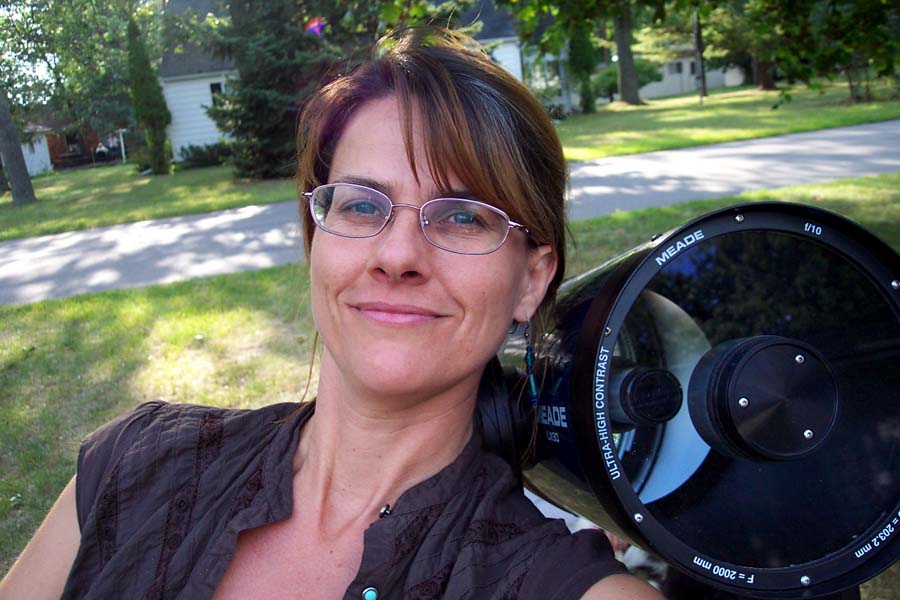

Wednesday, August 16, 2006
“Plutonic” Relationships
8/20/06 – 8/26/06
by C. Zaitz
Well, it’s finally come out. The IAU’s definition of a planet! How exciting- we’ve all been on the edge of our seats waiting and wondering, “so what is a planet, really?” The International Astronomical Union is the world-wide collection of astronomers making up the body that has been the official arbiter of planetary and satellite nomenclature since 1919. And they don’t take bribes.
Historically and etymologically, the word planet referred to the “wanderers” or the “stars” that moved as the year progressed. As the planets orbit the sun, they appear to move in front of the much more distant stars. Mercury, Venus, Mars, Jupiter and Saturn have been known since people have looked up and noticed them. However, Uranus wasn’t discovered by telescope until 1781 by Sir William Herschel. Neptune was discovered in 1846 by Johann Galle, and Pluto is a mere baby, discovered in 1930 by Clyde Tombaugh.
Thanks to better ground-based and orbiting telescopes, we’ve recently discovered even more members of our solar system. Two more moons of Pluto have been discovered, as well as other small bodies like Sedna and Quaoar with eccentric orbits that can take well over 200 years to orbit the sun, beyond the orbit of Neptune. Pluto, by the way, is substantially smaller than our Moon. Controversy has raged about the definition of a planet, and much of it surrounded Pluto’s status. One of the more vocal opponents of Pluto’s planetary status was Dr. Neil DeGrasse Tyson of NYC’s Rose Center and Hayden Planetarium. His argument was that Pluto was too small to be a planet, and was most likely another Trans-Neptunian Body, such as those mentioned above. But who wants to deny that Pluto is a planet? It’s on all our placemats, mobiles and coloring books!
Here’s the quote: “The IAU therefore resolves that planets and other Solar System bodies be defined in the following way: 1. A planet is a celestial body that (a) has sufficient mass for its self-gravity to overcome rigid body forces so that it assumes a hydrostatic equilibrium (nearly round) shape, and (b) is in orbit around a star, and is neither a star nor a satellite of a planet.” Basically, if it’s round and goes ‘round the sun, it’s a planet. That means you, Mr. Pluto. However, small bodies like Ceres, traditionally called asteroids or minor planets, are technically now planets, but can be called “dwarf planets.” Pluto is now a double planet, joined at the gravitational hip with Charon, but is head of a new subclassification called “Plutons,” namely the Trans-Neptunian objects. 2003 UB313 would fall into the Pluton classification. That would make a grand total of 12 planets in the solar system, pending more discoveries.
As you can see, this is all getting a little more complex than it used to be, but a complex solution was called for. We ran out of names and ways to classify the new discoveries. Dr. Tyson wasn’t mad at Pluto, he was pushing for a clearer, more accurate classification scheme.
The vote on the new scheme takes place in Prague on the 24th of August. Stay tuned!
Meanwhile, nary a planet can be found in our August sky. Jupiter can’t escape the oncoming blast of light from the Sun much longer, and soon will be lost in the glare of sunset. Catch a quick view right at evening twilight in the west. Early morning birds may catch a glimpse of Venus in the east, though she is low and her light will be washed away as the sun rises.
Until next week, my friends, enjoy the view!
For more from the IAU, try: http://www.iau2006.org/mirror/www.iau.org/iau0601/iau0601_resolution.html
by C. Zaitz
Well, it’s finally come out. The IAU’s definition of a planet! How exciting- we’ve all been on the edge of our seats waiting and wondering, “so what is a planet, really?” The International Astronomical Union is the world-wide collection of astronomers making up the body that has been the official arbiter of planetary and satellite nomenclature since 1919. And they don’t take bribes.
Historically and etymologically, the word planet referred to the “wanderers” or the “stars” that moved as the year progressed. As the planets orbit the sun, they appear to move in front of the much more distant stars. Mercury, Venus, Mars, Jupiter and Saturn have been known since people have looked up and noticed them. However, Uranus wasn’t discovered by telescope until 1781 by Sir William Herschel. Neptune was discovered in 1846 by Johann Galle, and Pluto is a mere baby, discovered in 1930 by Clyde Tombaugh.
Thanks to better ground-based and orbiting telescopes, we’ve recently discovered even more members of our solar system. Two more moons of Pluto have been discovered, as well as other small bodies like Sedna and Quaoar with eccentric orbits that can take well over 200 years to orbit the sun, beyond the orbit of Neptune. Pluto, by the way, is substantially smaller than our Moon. Controversy has raged about the definition of a planet, and much of it surrounded Pluto’s status. One of the more vocal opponents of Pluto’s planetary status was Dr. Neil DeGrasse Tyson of NYC’s Rose Center and Hayden Planetarium. His argument was that Pluto was too small to be a planet, and was most likely another Trans-Neptunian Body, such as those mentioned above. But who wants to deny that Pluto is a planet? It’s on all our placemats, mobiles and coloring books!
Here’s the quote: “The IAU therefore resolves that planets and other Solar System bodies be defined in the following way: 1. A planet is a celestial body that (a) has sufficient mass for its self-gravity to overcome rigid body forces so that it assumes a hydrostatic equilibrium (nearly round) shape, and (b) is in orbit around a star, and is neither a star nor a satellite of a planet.” Basically, if it’s round and goes ‘round the sun, it’s a planet. That means you, Mr. Pluto. However, small bodies like Ceres, traditionally called asteroids or minor planets, are technically now planets, but can be called “dwarf planets.” Pluto is now a double planet, joined at the gravitational hip with Charon, but is head of a new subclassification called “Plutons,” namely the Trans-Neptunian objects. 2003 UB313 would fall into the Pluton classification. That would make a grand total of 12 planets in the solar system, pending more discoveries.
As you can see, this is all getting a little more complex than it used to be, but a complex solution was called for. We ran out of names and ways to classify the new discoveries. Dr. Tyson wasn’t mad at Pluto, he was pushing for a clearer, more accurate classification scheme.
The vote on the new scheme takes place in Prague on the 24th of August. Stay tuned!
Meanwhile, nary a planet can be found in our August sky. Jupiter can’t escape the oncoming blast of light from the Sun much longer, and soon will be lost in the glare of sunset. Catch a quick view right at evening twilight in the west. Early morning birds may catch a glimpse of Venus in the east, though she is low and her light will be washed away as the sun rises.
Until next week, my friends, enjoy the view!
For more from the IAU, try: http://www.iau2006.org/mirror/www.iau.org/iau0601/iau0601_resolution.html
Subscribe to:
Posts (Atom)